
SEARCH
MENU
Disclosures Based on the Recommendations of the TCFD
- Foreword (Recognition of the Current Situation and Approach to Climate Change)
- Governance
- Strategy
- Risk Management
- Metrics & Targets
- The Haseko Group’s CO2 Emissions Reduction Plan (Transition Plan)
Foreword (Recognition of the Current Situation and Approach to Climate Change)
The Haseko Group, as a leading company in “housing” and “living,” aims to “contribute to society by creating an optimal environment for cities and people.” However, in recent years, natural disasters have increased in frequency and intensity due to climate change, which is threatening the safety and security of our lives.
Given these conditions, with the belief that addressing climate change is an important management issue, the Haseko Group endorsed the recommendations of the TCFD (Task Force on Climate-Related Financial Disclosure), as well as developed and announced its policy addressing climate change, HASEKO ZERO-Emission in December 2021. We will continue to make disclosures in accordance with the recommendations of the TCFD, as well as monitor and appropriately deal with governmental measures and social trends related to the impacts of climate change and efforts to reduce CO2 and other greenhouse gas emissions, while aiming to realize a sustainable society and improve corporate value.
Governance
The Haseko Group has also established a Sustainability Committee chaired by the President of Haseko Corporation under the Board of Directors. This committee deliberates and approves sustainability-related policies and activity plans, which include climate change, and monitors, and reviews such activities. A Sustainability Promotion Conference, which is a subordinate body under the committee, deliberates and implements specific measures that include environmental initiatives such as decarbonization and energy and environmental technologies. Its Climate Change Response Working Group promotes measures to combat climate change, such as the reduction of GHG (CO2) emissions and the introduction of renewable energy.
Matters deliberated and matters for reporting that arise in meetings of the Sustainability Committee are reported to and overseen by the Board of Directors, and important matters are passed to the Board of Directors for deliberation and decision making. Furthermore, climate-related management issues compiled by the Sustainability Committee are taken into account during considerations on business strategy, investment strategy, and other aspects of the Haseko Group’s management strategy.
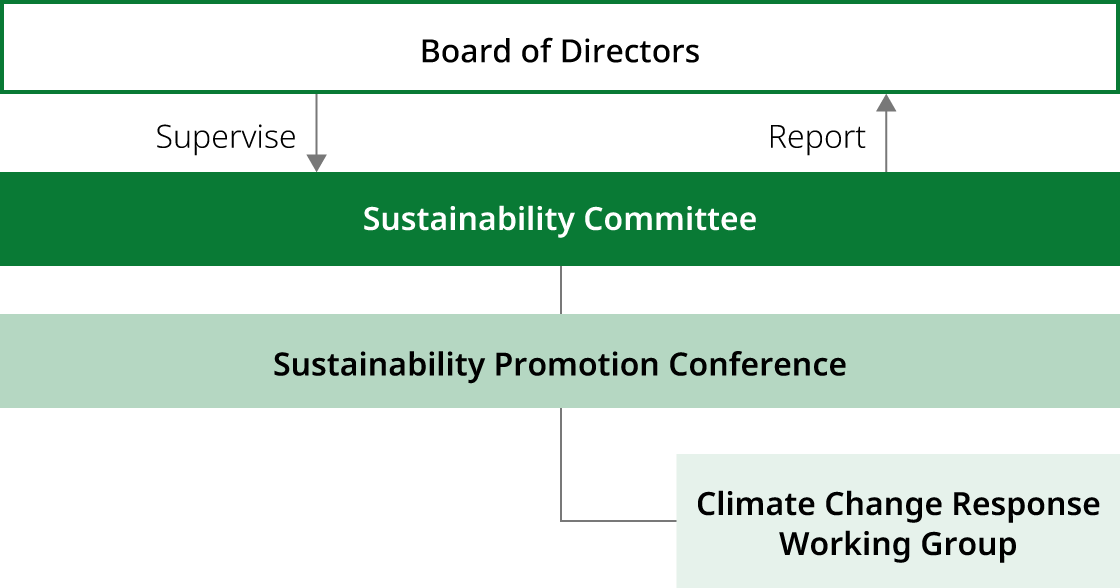
| Body | Role | Composition | Frequency of meetings | Secretariat |
|---|---|---|---|---|
| Sustainability Committee | Deliberates and decides matters on sustainability management at the management level | [Chairperson] President of Haseko Corporation [Members] Officers in charge of Haseko Corporation divisions and Haseko Group company presidents |
Twice a year | Sustainability Promotion Department |
| Sustainability Promotion Conference | Deliberates and executes specific measures for sustainability management | [Members] Operating officers and managers of Haseko Corporation and Haseko Group companies | Three times a year | |
| Climate Change Response Working Group | Realization and horizontal rollout of CO2 emission reduction measures across the Haseko Group, and calculation and disclosure of CO2 emissions | [Members] Haseko Corporation and Group company staff members engaged in responding to climate change | Once a month | Integrated Disclosure Promotion Office |
Strategy
Risk and Opportunity Identification Process
The Haseko Group established a Group-wide working group (WG) to address climate change under the Sustainability Promotion Conference. This WG identifies climate-related risks and opportunities, analyzes the level of impact, and studies responses thereto.
The study results are approved by the Sustainability Committee after deliberation on the validity of the analysis and the need for additional response, and then reported to the Board of Directors.
Targeted Sectors/Regions and Impact on Financial Plans
Our analysis targets all business sectors of the Group. Regarding financial impact, in addition to qualitative analysis, we also perform some quantitative impact calculations where possible.
Explanation of Scenarios and Short-, Medium-, and Long-term Time Horizons
In our analysis, we established the following two scenarios to study the impact.
| 1.5ºC scenario | A scenario in which rigorous measures to mitigate climate change are taken and temperatures as of 2100 are no more than 1.5ºC warmer than before the Industrial Revolution. (References: NZE of the IEA*1, RCP 2.6 of the IPCC*2, etc.)
|
|---|---|
| 4ºC scenario | A scenario in which rigorous measures to mitigate climate change are not taken and temperatures as of 2100 are around 4ºC warmer than before the Industrial Revolution. (References: STEPS of the IEA, RCP 8.5 of the IPCC, etc.) |
We also analyze the impact from short-term, medium-term (through 2030), and long-term (through 2050) perspectives.
Climate-Related Issues That Have a Significant Impact and Resilience
As a result of analysis, we identified significant risks such as the increase in construction costs due to the adoption of a carbon tax and tighter regulations in connection with the transition to a decarbonized society, labor shortages due to rising average temperatures in summer, and delays in construction projects due to more frequent and intensified meteorological disasters.
On the other hand, our analysis indicates that the increasing demand for ZEH (Net-Zero Energy Houses) and disaster-resilient housing may lead to an increase in opportunities to receive orders for new construction and renovations as well as other related projects.
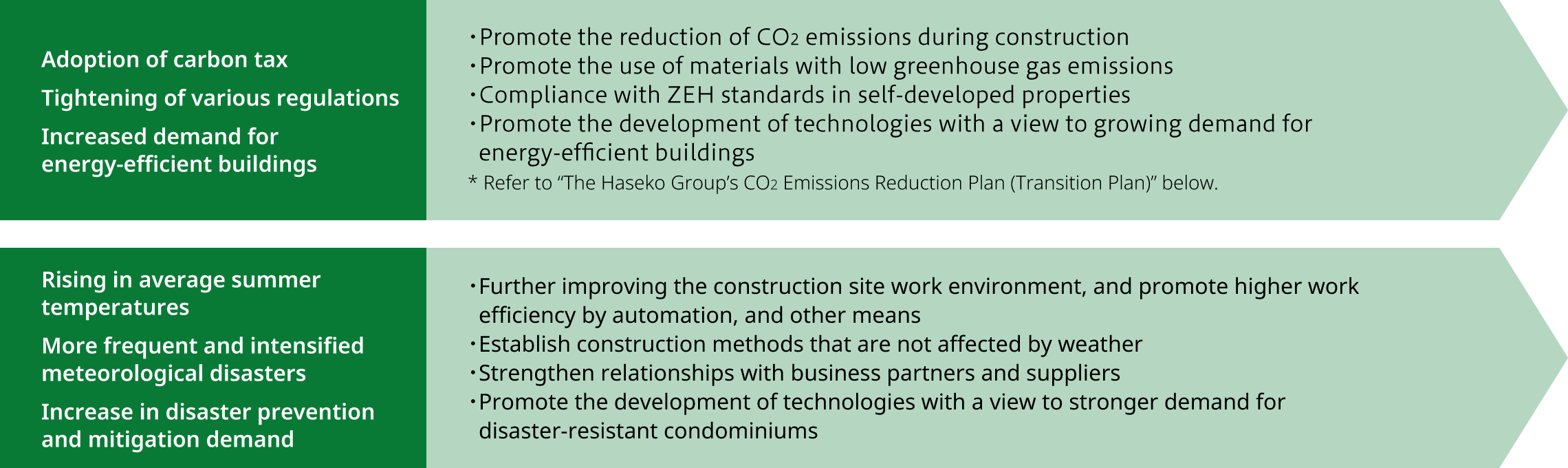
Additionally, every time the analysis is updated, we review the status of initiatives addressing identified risks and opportunities and assess their adequacy and the need for additional measures. As a result, as shown in the Countermeasures table below, we are conducting initiatives such as CO2 emission reductions, improving work efficiency through mechanization and other efforts, and developing related technologies. By steadily advancing these initiatives, we aim to minimize the impact of risks and maximize the impact of opportunities, thereby enhancing the resilience of the Haseko Group.
- See The Haseko Group’s CO2 Emissions Reduction Plan (Transition Plan) below regarding implementation of CO2 emission reduction.
Please see the chart below for details on significant risks and opportunities, their impact, and our response.
Risks and Opportunities
- “Impact” means the impact as of 2030.
| Category | Item | Description | Impact | Timeframe | ||
|---|---|---|---|---|---|---|
| 1.5℃ | 4℃ | |||||
| Impact of the transition to a decarbonized society | Risk | Adoption of carbon tax | If a carbon tax is adopted, business operating costs may increase through rising energy and goods prices (common to all businesses). In particular, the impact on construction costs (construction business) and property development costs (real estate business) is expected to be relatively large within the Group’s businesses due to rising transportation costs and prices of materials with high CO2 emissions intensity. |
Medium | Low | Medium-term |
| Risk | Tighter regulations | If the scope of compliance under the Act on the Improvement of Energy Consumption Performance of Buildings is expanded and energy-saving standards are raised/mandated, or other regulations are tightened, construction costs (construction business) and property development costs (real estate business) may increase. Additionally, if regulations on existing buildings are tightened, costs for equipment replacement and renovations will arise (real estate business). |
Medium | Low | Medium-term | |
| Opportunity | Increased demand for energy-efficient buildings | Demand for ZEH in new construction may increase, leading to competitive advantages (construction business and real estate business). Additionally, demand for energy-efficient renovations of existing buildings may increase, creating business opportunities (construction business). Furthermore, high environmental performance of owned rental properties and other properties may lead to competitive advantages (real estate business). |
High | Medium | Medium-term | |
| Physical effects | Risk | Rising average temperatures in summer | If average summer temperatures rise, the risk of heatstroke among construction site workers will increase, and the tendency to avoid outdoor work will grow, leading to labor shortages. Additionally, increased work interruption times due to weather conditions as heatstroke prevention measures may increase the risk of construction delays (construction business). Furthermore, delays in property development construction for similar reasons may lead to decreased sales of condominiums and rentals (real estate business). |
High | High | Short-term |
| Risk | More frequent and intensified meteorological disasters | Increased frequency of typhoons and intensified heavy rains may lead to work interruptions due to damage to buildings under construction, harm to nearby third parties, and difficulties in procuring materials and labor due to supplier damage, increasing the risk of construction delays (construction business and real estate business). Additionally, recovery costs due to damage to owned properties are also expected (real estate business). For other businesses as well, increased business operating costs due to rising goods prices from supply chain disruptions and decreased productivity due to employee damage are expected (common to all businesses). |
Medium | Medium | Short-term | |
| Opportunity | Increase in disaster prevention and mitigation demand | The frequent and intensified occurrence of meteorological disasters may increase the demand for disaster-resilient housing, leading to more opportunities for new construction and renovations (construction business). Additionally, disaster-resilient housing may also lead to competitive advantages in condominiums and rentals (real estate business). |
High | High | Medium-term | |
Countermeasures
Risk Management
We have established a company-wide working group to sort out climate change risks and analyze their impact on business. The risks analyzed by the working group are deliberated by the Sustainability Committee and reported to the Board of Directors.
Regarding the financial impact, we qualitatively evaluated the likelihood and timing of risks materializing, the potential impact if they materialize, and the status of current countermeasures. Additionally, for some risks where possible, we calculated the quantitative impact amount. Based on this assessment, we categorized the impact level as high, medium, or low.
In anticipation of a variety of risks, Haseko endeavors to collect risk-related information and prepares preventive measures and appropriate countermeasures in advance against risks according to their magnitude and possibility of arising. Through these efforts, Haseko aims to minimize the potential losses and to systematically cope with risk management centering on the Risk Management Department.
Specifically, Haseko has set up a system in which respective sections of the Management Division coordinate with each other and check the status of business operations in accordance with the roles they are assigned, while the Internal Auditing Department conducts further checking. For the corporate approval system that serves as a record of decision-making for work implementation, the Company has introduced an electronic system which enables auditors and the Management Division to view and check the content at any time.
Furthermore, of the issues forwarded to the Board of Directors, the Management Council and the two operation councils (the Business Operation Council and Technology Operation Council), those involving many departments or requiring specialized knowledge are subject to sufficient verification in advance by the adequately established advisory meetings and committees. Periodical results reports are also mandatory for issues that require monitoring.
On top of these, the Company established the Risk Management Council under the chairmanship of the President with the aim of strengthening the risk management system of Haseko and its entire Group, and conducts cross-sectional collection of information, analysis, evaluation, and handling of risks in accordance with the internal rules on risk management.
Going forward, we will continue to strengthen the risk management system, with the aim of further enhancing risk management.
Metrics & Targets
The Haseko Group has set reduction targets with total greenhouse gas (CO2) emissions as an indicator in order to evaluate and manage the impact of climate issues on management.
(Haseko obtained Science Based Targets (SBT) approval for these targets.)
| Scope | Base year | Target | |
|---|---|---|---|
| Medium-term (FY2030) |
Long-term (FY2050) |
||
| Scope 1*1 + Scope 2*2 | FY2020 | -42% | -100% |
| Scope 3*3 | -13% | -37% | |
- For information on actual emission figures and the calculation method, please see the separately disclosed ESG Data. (Total greenhouse gas (CO2) emissions are calculated according to GHG Protocol.) We are receiving third-party verification of actual figures from FY2022 onward.
- For single year targets, please see the separately disclosed Environment Policy / Management System.
- Scope 1: Direct emissions from burning fuel, etc.
- Scope 2: Indirect emissions from the use of electricity, etc.
- Scope 3: Supply chain emissions related to business activities
We have also set the following targets to achieve these targets.
- Transition to 100% renewable energy sources for electricity use on construction sites (in FY2025)
- Transition to 100% renewable energy sources for electricity use at offices and similar locations (in FY2026)
- Achieve zero Scope 2 emissions (in FY2026)
- Achieve 50% or more use rate of H-BA concrete (environmentally friendly concrete) (by 2030)
- Achieve adherence to ZEH-M Oriented standard in condominiums developed primarily by the Group (all condominiums designed in FY2022 or later)
- Achieve 100% of compliance with ZEH-M Oriented standards in construction projects by the Group (FY2030)
All Group companies will continue to study measures for achieving greenhouse gas emission reduction targets (and targets for promoting these measures).
- Climate change: ESG Data
- Independent Verification Report on Environmental Information
- FY2024 environmental goals/numerical targets and results and FY2025 plan: Environmental Management System
Internal Carbon Pricing
We have introduced Internal carbon pricing to promote decarbonization initiatives.
Specifically, we raise awareness for the necessity of decarbonization and encourage action by converting the CO2 emissions of each group company into monetary values through internal carbon pricing and indicating them as a carbon tax or other potential future cost for each company.
The internal carbon pricing level is currently set at 21,000 yen per ton of CO2 emissions. This is the yen conversion of the International Energy Agency (IEA) forecast value (“Net Zero by 2050” scenario, developed countries, 2030), and it will be revised if this forecast is updated.
Going forward, we will also consider using internal carbon pricing as a decision-making criterion for investments related to decarbonization measures.
The Haseko Group’s CO2 Emissions Reduction Plan (Transition Plan)
The Haseko Group pursues initiatives to reduce CO2 emissions in accordance with the plan set out below in order to help to prevent global warming, as well as reduce the risks and pursue the opportunities that come with the transition to a decarbonized society.
For CO2 emission results, please refer to the ESG data.
1. The Plan Until FY2030
(1) Scope 1 and 2 (FY2030 target: achieve a 42% reduction compared to FY2020)
(i) Scope 1
As described below, our policy is to prioritize reduction of Scope 2 emissions for the time being, but we will also promote reduction of
Scope 1 emissions in order to meet the FY2030 target.
a. Construction sites
Scope 1 emissions from construction sites are generated by the combustion of fossil fuels used by heavy machinery and transportation vehicles. In addition to thoroughly implementing our existing energy-saving activities such as using idle start-stop systems, ensuring appropriate maintenance and servicing of heavy machinery and vehicles, and reducing the number of transportation vehicles required by making effective on-site use of soil generated from construction, we aim to achieve further reductions in emissions by promoting the introduction of low carbon fuels and electric forklifts. Commercialization of electric backhoes and other large-scale heavy machinery has yet to progress beyond the prototype stage, but we aim to officially introduce these in the late 2020s based on the rate of industry adoption.
b. Offices, etc.
Scope 1 emissions from offices, etc. are generated by the combustion of fossil fuels used by the various Group companies’ sales vehicles, the Senior Living Business’s shuttle vehicles, and for cooking services and hot water supply in senior living facilities. In addition to thoroughly implementing our existing energy-saving activities such as using idle start-stop systems and ensuring appropriate maintenance and servicing of vehicles, we aim to achieve further reductions in emissions by promoting the adoption of hybrid vehicles and EVs, and target to fully introduce EVs in the late 2020s.
(ii) Scope 2
Currently, our initiatives prioritize the reduction of Scope 2 emissions as described below, with the aim of achieving zero Scope 2 emissions by FY2026. Scope 2 emissions comprised 36% of our total Scope 1 + Scope 2 emissions in FY2020, and achieving zero Scope 2 emissions will be a great step towards achieving our FY2030 target of reducing total Scope 1 + Scope 2 emissions by 42% compared to FY2020.
a. Construction sites
In December 2021, with the establishment of The Haseko Group’s Climate Change Response Policy: HASEKO ZERO-Emission, we announced a target of switching to 100% renewable energy sources at construction sites by the end of 2025. Initiatives for achieving this are progressing steadily, and for construction sites solely managed by Haseko Corporation, we achieved a 100% transition to renewable energy electricity in May 2023, and for construction sites of Group companies, we achieved the same in March 2025.
b. Offices, etc.
Beginning with the Group’s major facilities, we are also progressively transitioning to renewable energy sources at the offices and rented properties of each Group company. We will reduce our emissions in stages, including by purchasing non-fossil certificates to achieve substantial conversion to renewable energy in respect of rented properties where switching to renewable energy sources is difficult, and continue with our aim to achieve zero Scope 2 emissions in FY2026.
(2) Scope 3 (FY2030 target: achieve a 13% reduction compared to FY2020)
The bulk of the Haseko Group’s Scope 3 emissions are emissions generated from the manufacture of construction materials purchased (Category 1) and generated by day-to-day electricity and gas consumption by the residents of the properties constructed or developed by the Group (Category 11). Our initiatives for reducing these emissions are described below.
- In FY2020, Category 1 emissions made up 33% of Scope 3 emissions, while Category 11 emissions made up 60% of the same. In total, both categories made up 93% of Scope 3 emissions.
(i) Category 1
We promote the use of H-BA Concrete, an environment-conscious concrete that was developed in-house, in buildings developed primarily by the Group companies. In addition, we have set a target for H-BA Concrete to be adopted in 50% or more of projects by FY2030, and we are actively promoting these proposals to various project owners. We also pursue initiatives to promote wood use in construction. As collaboration with suppliers of construction materials and project owners is essential for reducing Category 1 emissions, we will continue to enhance our collaboration and proposals with them with the aim of reducing emissions.
(ii) Category 11
We are continuing with initiatives to promote ZEH-M. In particular, all new condominiums (for-sale and rental) developed primarily by the Group designed in FY2022 or later adhere to the ZEH-M Oriented standard. In addition, we are improving our proposals to project owners with specifications that meet the ZEH-M Oriented standard. As collaboration with project owners is essential for reducing Category 11 emissions, we will continue to enhance our collaboration and proposals with them with the aim of reducing emissions.
- ZEH-M is an abbreviation for Net Zero Energy House Mansion. ZEH-M condominiums are equipped with features to reduce energy consumption by virtue of improved exterior thermal insulation, highly efficient equipment, and adoption of renewable energy. ZEH-M Oriented condominiums meet specified thermal insulation and energy consumption standards.
2. Toward Achieving Our FY2050 Targets
In order to achieve our FY2050 reduction targets, it is essential to utilize the advanced technology being researched and developed (or that will be researched and developed in the future) at various sites. As a business, implementation of the emissions reduction measures must align with the intentions of condominium residents and other end users. In this regard, another key element will be trends in available government schemes and other support measures. The Group will monitor these external trends while investigating specific emission reduction measures, and will continue its research and development activities as well as its collaborations and joint efforts with its various corporate stakeholders.
3. System for Implementing and Managing the Plan
A company-wide working group established under the Sustainability Promotion Conference formulates and implements the CO2 Emissions Reduction Plan, the details of which are reported to Haseko Corporation’s Board of Directors for approval. The status of progress on the plan is also periodically reported to the Board of Directors. Where changes in the Company’s internal or external environment require changes to the plan, we will revise the plan using the same processes described above.
| By FY2025 | By FY2030 | By FY2050 | ||
|---|---|---|---|---|
| CO2 reduction target (vs FY2020) | Scope 1, 2 -42% | Scope 1, 2 -100% | ||
| Scope 3 -13% | Scope 3 -37% | |||
| Scope 1 FY2020 emissions: 39,000 t-CO2 (64% of Scope 1 and 2) |
Construction sites |
|
|
|
| Offices, etc. |
|
|
|
|
| Scope 2 FY2020 emissions: 22,000 t-CO2 (36% of Scope 1 and 2) |
Construction sites |
|
|
|
| Offices, etc. |
|
|||
| Scope 3 FY2020 emissions: 5,500,000 t‑CO2 |
Construction materials, etc. (Category 1) |
|
|
|
| Building use stage (Category 11) |
|
|
|
|
Related Information
Haseko Group's Sustainability
Related Data / Integrated Report
Special Features
- Human Capital / Human Resource Development
- Diversity & Inclusion / Labor Environment
- Occupational Safety and Health / Health and Productivity Management
- Enhancing Safety and Quality in Buildings and Services
- New Value Creation
- Community
- Research and Technology Development
- Social Contribution Activities