
SEARCH
MENU
Compliance / Risk Management
- Compliance
- Basic Approach & Policy
- Structure
- Compliance Promotion Initiatives
- Internal Whistleblowing System
- Prevention of Bribery and Corruption
- Elimination of Anti-Social Forces
- Prevention of Harassment
- Information Security and Protection of Personal Information
- Responsible Advertising and Publicity
- Risk Management
- Basic Approach & Policy
- Structure
- Promotion of Risk Prevention Efforts
- Business Continuity Plan (BCP)
Compliance: Basic Approach & Policy
With the recognition that intensive compliance is indispensable for the continuity of a corporation, the Company established the Haseko Group Code of Conduct, under which Haseko has been working to establish a management system where all directors, operating officers, and staff respect societal standards and take sensible courses of action in keeping with their duties as members of society, as well as complying with all laws and regulations both in Japan and abroad, and the Company’s articles of incorporation, so that the Company can win the confidence of society.
The Company regularly reviews the Code of Conduct for relevancy and effectiveness and revises it as needed.
System for Promoting Compliance
The Compliance Office, established in the Risk Management Department as a department responsible for instilling the Code of Conduct across the Group and advancing compliance efforts, works to enhance the Group’s compliance.
In addition, pursuant to internal rules and regulations on internal audits, the Internal Auditing Dept., which is under the direct control of the President, investigates and evaluates whether activities of all divisions, including Group companies, conform to laws and regulations, the Articles of Incorporation, the Company's rules and regulations, corporate policies, etc. and whether they are reasonable, and works to make improvements based on the results. The frequency of audits is determined based on risks. Audits are implemented at least once every three years for major divisions and Group companies.
If there is any act violating the Code of Conduct that causes concern that it might produce a material effect, it will be reported to the President, and officers in charge of risk management will make an investigation. As needed, the Compliance Committee chaired by officers in charge of risk management or the President of the Company is convened to work to resolve it through such actions as examining circumstances, analyzing causes, identifying remedies, investigating whether there are any similar events, devising measures for preventing recurrence, and sharing the results in the Company and across the Group.
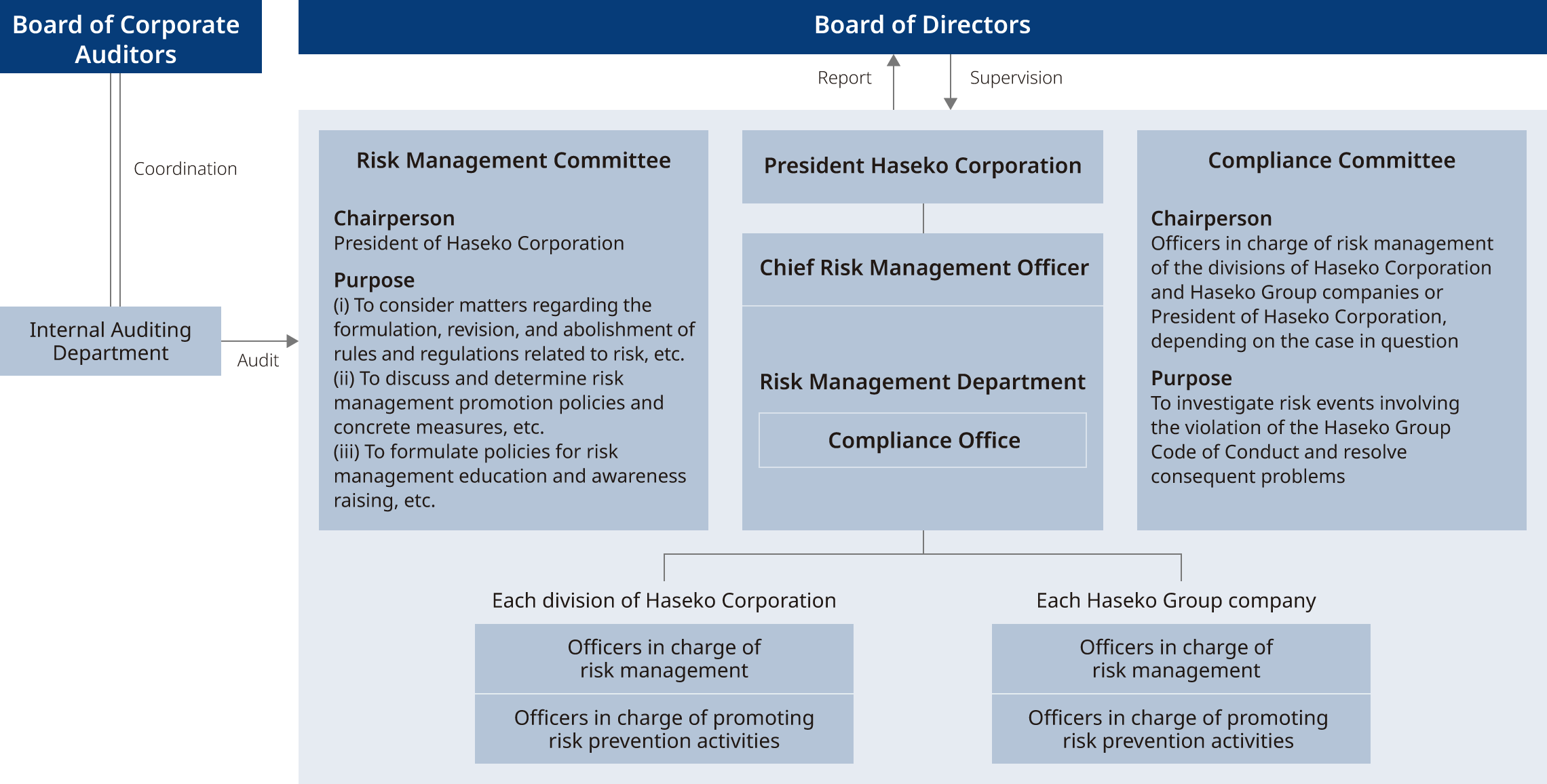
Roles of the Compliance Office
(i) Address requests for consultation concerning compliance
(ii) Investigate violations by officers and employees of the Code of Conduct and give corrective instruction
(iii) Communicate information concerning compliance
(iv) Promote education, awareness raising, etc., regarding compliance
Promoting Compliance
Risk prevention efforts
To prevent compliance issues, the Company is making risk prevention efforts for risks concerning compliance, including identifying and assessing risks, formulating plans for countermeasures, and implementing risk mitigation measures, as it does for risks in other areas.
Education and awareness raising
To instill the fundamental aspects of code of conduct and compliance, all officers and employees have been provided with the Haseko Group Compliance Book. Information is also provided periodically online through the intranet to promote compliance, and e-learning programs are offered to all officers and employees, including contract employees and temporary employees as an education initiative. We are also raising awareness regarding compliance by having all officers and employees consent to the Haseko Group Compliance Guideline.
FY2024 implementation measures
- Review of and agreement with compliance guidelines (target: all Group officers and employees)
- E-learning (twice) (target: all Group officers and employees)
- Compliance training session (twice) (target: selected for each theme)
- Compliance newsletter (monthly) (recipients: all Group officers and employees)
- Compliance awareness column (twice a month) (target: all Group officers and employees)
- Display of posters on harassment prevention, etc.
Internal Whistleblowing System
The Haseko Group has set out the Haseko Group Whistleblower Protection Rules pursuant to the Whistleblower Protection Act and relevant laws and regulations. In addition, the Company has established an office in the Compliance Department of the Risk Management Department, as well as in a law firm as an external contact, dedicated to receiving public-interest whistleblowing reports by officers and employees and requests for consultation regarding harassment and compliance issues in general (including issues concerning the prevention of corruption such as graft and bribery). The reports and requests may be filed anonymously. The Company has put in place a system for protecting whistleblowers and preserving their anonymity and created an environment where employees feel free to file a report or request consultation in order to ensure that any wrongful act or misconduct be immediately detected and corrected.
Regular reports are made to representative directors, outside directors, and auditors regarding contact made to the internal whistleblowing consultation desk, and the response status.
Prevention of Bribery and Corruption
The Haseko Group endeavors to ensure compliance and to prevent bribery and corruption.
The Haseko Group Code of Conduct stipulate measures for preventing bribery and corruption, and in accordance with the standards, the Company has taken actions, such as distributing Haseko Group Compliance Book to all officers and employees and offering e-learning programs.
For relationships with public employees and the like, while the Company believes that, overall, its exposure to the risk of bribery, etc., is not so high because the construction projects in which the Group is engaged are mostly private-sector projects, the Company, as part of risk prevention efforts, has implemented in high-risk departments a system in which the self-checking function autonomously works. How this checking function is working is examined in internal audits.
For relationships with business partners, the Purchasing Business Regulations prohibit departments involved in purchasing, which have many opportunities for negotiation, from using their status or authority within the company to seek personal benefits from business partners. Moreover, we have concluded memoranda with major business partners related to the elimination of fraudulent activity by employees of the Company and reporting via our internal whistleblowing system.
We have also taken the following measures to prevent bribery and corruption.
- The Haseko Group Code of Conduct stipulate that we will endeavor to engage in proper accounting and taxation treatment. Having established frameworks and procedures accordingly, we strictly ensure proper treatment.
- Having established the Regulations on Confirmation (of Individuals) at the Time of Transactions based on the Act on Prevention of Transfer of Criminal Proceeds, we thoroughly take measures such as confirmation at the time of transactions and the reporting of suspicious transactions to prevent the transfer of criminal proceeds. We also prepare evaluation sheets on the risk of transfer of criminal proceeds (revised as necessary) to analyze the risk of transfer of criminal proceeds based on classifications such as the products or services handled, the form of transaction, counterparty attributes, etc., and make related departments broadly aware of money laundering risks and thorough compliance with the Act on Prevention of Transfer of Criminal Proceeds.
We review our assessment of bribery and corruption risks each fiscal year, in the same way as for other risks, as part of the risk prevention efforts implemented by the Group. In addition to revising the content of our countermeasures as necessary based on the results of this assessment, we boost their effectiveness through confirmation as part of internal audits.
We also request that all business partners (not only suppliers but also subcontractors, agents, and others) comply with the Haseko Group Sustainable Procurement Guidelines. In addition, we obtain signed agreements from main business partners expressing a commitment to follow these guidelines (similar agreements are obtained from new business partners when they commence transactions) and implement questionnaires on the results of self-assessment by business partners concerning their compliance with each item in the guidelines to check whether there are any issues.
Corruption-related fines and penalties
The Haseko Group was not subject to any fines or penalties for legal or regulatory violations related to corruption in FY2024.
Excerpts from the Haseko Group Code of Conduct
3. Sound and Good-Faith Business Activitie
(8) Prevention of bribery and corruption
Officers and employees shall not provide improper benefit to public officers and other comparable persons. Furthermore, officers and employees shall not directly or indirectly provide or accept entertainment, gifts, or other benefit in excess of business practices and social common sense in all areas of corporate activities.
(9) Donations and political contributions
When making political contributions or donations and the like to various organizations, officers and employees shall comply with the Public Offices Election Act, Political Funds Control Act, and other relevant laws and regulations, adequately consider the necessity and appropriateness of such political contributions or donations, and act in accordance with internal rules and so on.
Elimination of Anti-Social Forces
The Company has no relations with anti-social forces or groups that threaten the order and security of civic life, and will cope with such anti-social forces and groups systematically, and with an adamant and resolute attitude.
The Haseko Group Code of Conduct also stipulate to that effect, and the Company has distributed the Haseko Group Compliance Book to all officers and employees, and has offered e-learning programs to ensure the elimination of anti-social forces.
In addition, as part of risk prevention efforts, the Company has embedded in the Group-wide operation flow the steps of confirming before starting a transaction that the counterpart is not part of anti-social forces and incorporating the anti-social force clause into contracts and equivalent documents, and has made these steps mandatory.
Excerpts from the Haseko Group Code of Conduct
3. Sound and Good-Faith Business Activitie
(12) Severance of relationships with anti-social forces
If an improper demand is received from anti-social forces, officers and employees shall refuse the demand and shall not engage in any transactions and the like with the relevant companies. Furthermore, officers and employees may not use anti-social forces under any circumstances.
Prevention of Harassment
The Haseko Group believes that preventing harassment is essential to achieving a favorable working environment in which everyone in the workplace can demonstrate their ability while respecting personality and values with one another.
To prevent harassment, the Company has set out Prohibition of Harassment under the Haseko Group Code of Conduct and its Employment Regulations, and has ensured to keep everyone informed thoroughly about acquisition of correct knowledge of harassment and the way how to respond to harassment if it occurs in the workplace, by sending information through the intranet, implementing e-learning education, and holding seminars, continuously.
In addition, to make the Group’s policy for harassment even clearer, the Company has established the Haseko Group Harassment Prevention Rules which applies to Group officers and employees, temporary employees, employees of contractors, and all who are engaged in the operation of the Haseko Group. The Company will work to ensure the objectivity and adequacy of the Group’s measures regarding harassment by establishing and implementing procedures for addressing harassment in the workplace (flow for collection, review, and judgment of harassment cases) in the rules.
In November 2023, we conducted training for management across the entire group, covering how to respond to incidents of harassment in the workplace.
Information Security and Protection of Personal Information
Information security
In recent years, there has been a growing risk of information assets being exposed to threats in various aspects in line with the progress of information technology.
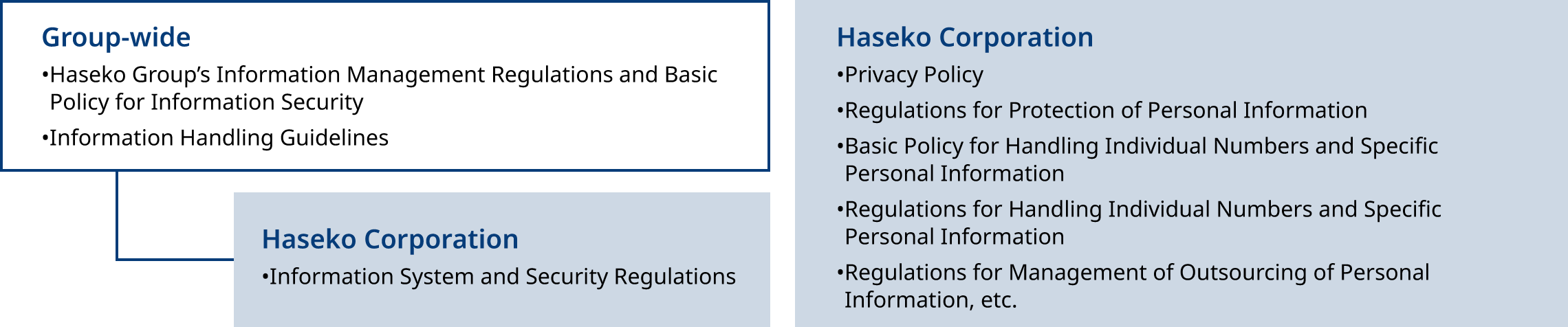
The Haseko Group is working on the protection of information assets handled in its businesses and the enhancement of management of such assets, including customer information. We are building awareness of information management, having established the Haseko Group’s Information Management Regulations and Basic Policy for Information Security on a Group-wide scale and formulated the Information Handling Guidelines shared across the Group. We have also set individual management standards according to the respective businesses and contents of information handled by Group companies.
Haseko Livenet, Inc., which is engaged in the operational management of rental housing, handles personal information of residents and prospective residents as well as information assets entrusted by clients. For this reason, we have built an Information Security Management System (ISMS) in all divisions in Tokyo and Osaka. We are utilizing international standard ISO/IEC 27001 in the inspection and review of day-to-day information asset management activities, having obtained certification in August 2005.
Protection of personal information
The Haseko Group recognizes the importance of protecting personal information, and has established the Privacy Policy with respect to all companies in the Group as our policy for handling personal information.
In order to clarify the structure of responsibility for the protection of personal information inside all companies in the Group, we have appointed a personal information protection manager and developed internal regulations on personal information, and are educating employees and raising their awareness so that they would comply with such regulations.
We have also established the Guidelines for Handling Personal Information in Information Systems, which set forth the system requirements and operation rules of information systems that handle personal information, laying down the rules of the administration framework and operation method of systems that fall under the scope.
Furthermore, we execute thoroughgoing management and take various security measures to prevent the loss and leakage of personal information. We conduct internal audits periodically to verify that the series of measures to protect personal information are being implemented without fail, and take corrective action as necessary. In addition, we have undergone PrivacyMark (P-Mark) assessment to have our personal information protection status evaluated objectively by a third party, as a result of which two Group companies have been granted P-Mark.
Responsible Advertising and Publicity
Management and audit system
The Company has put in place a system for inspecting and assessing the contents of its advertisements as needed to ensure compliance with relevant laws and regulations and to appropriately conduct advertising activities.
The Company has set its rules for management based on the Act against Unjustifiable Premiums and Misleading Representations, and put in place a system in which the Company appoints the person in charge of management of representations and the person in charge of safekeeping of materials for representations for each department and the person in charge of management of representations inspects a representation in advance by using a checklist to confirm that it does not infringe the Act and then grants approval.
In addition, the Company holds the Product Representations Check Meeting as needed to inspect for appropriateness the contents of representations made by Group companies in advertisements for products, etc. that they sell.
Haseko Corporation’s Internal Auditing Dept. periodically confirms the status of checks by each Group company through internal audits.
Training and awareness
For the Real Estate Brokerage Act, the Company holds an internal seminar every year to ensure compliance with the Act and other laws and regulations, and Group companies engaging in sales of real estate have adopted a system in which they check the contents of a representation every time they place an advertisement.
Haseko Urbest Inc. and Haseko Real Estate, Inc., which are mainly engaged in consignment sales of condominiums and real estate brokerage, respectively, regularly share any cases of inappropriate representations discovered through these checks across all departments and call attention to such issues.
Risk Management: Basic Approach & Policy
The Haseko Group has set out the Haseko Group Risk Management Policy with the aim of properly managing various internal and external business risks associated with its operations and continuing to maintain and enhance its corporate value. The Company has put in place its Risk Management System, and has ensured that rules and measures under the policy are known and implemented by all Haseko Group officers and employees.
Haseko Group Risk Management Policy
The Company will determine the following risk management policy and ensure that it is implemented by all officers and employees to live up to the trust society places in the Company.
The Risk Management Committee will develop a risk prevention plan, and based on the plan, the Company will carry out the process from collecting and assessing risk information and implementing improvement measures to operational auditing, with the Risk Management Department taking a central role.
In the event of a crisis, the Company will promptly respond to it in accordance with rules and regulations that stipulate the procedures for addressing expected crises to minimize the impact and ensure that it will not recur.
Risk Management System
The Haseko Group has adopted a risk management system in which the President of Haseko Corporation serves as Chief Officer to implement the “Haseko Group Risk Management Policy.” The Company has also appointed a Chief Risk Management Officer, who is responsible for overall risk management, including risk prevention and crisis response across the Group, and officers in charge of risk management, who are responsible for leading risk management in each operating division of Haseko Corporation and the Group companies. In addition, the Company has appointed risk prevention activity promotion officers who are responsible for promoting risk prevention activity in each division of the Group.
In addition, each Group company has its risk management department, which makes advice and recommendations regarding the formulation and implementation of Group-wide measures for promoting risk management and monitors the progress of these measures.
The Company has also established the “Risk Management Committee” under the chairmanship of the President of Haseko Corporation. The committee meets once every quarter, while convening an extraordinary meeting as needed when a serious risk event occurs, and works to collect, analyze, assess, and address risk events across the Company. The results of discussions of the “Risk Management Committee” are reported as needed to the Board of Directors, which assesses and oversees the implementation and effectiveness of the Risk Management System.
Promotion of Risk Prevention Efforts
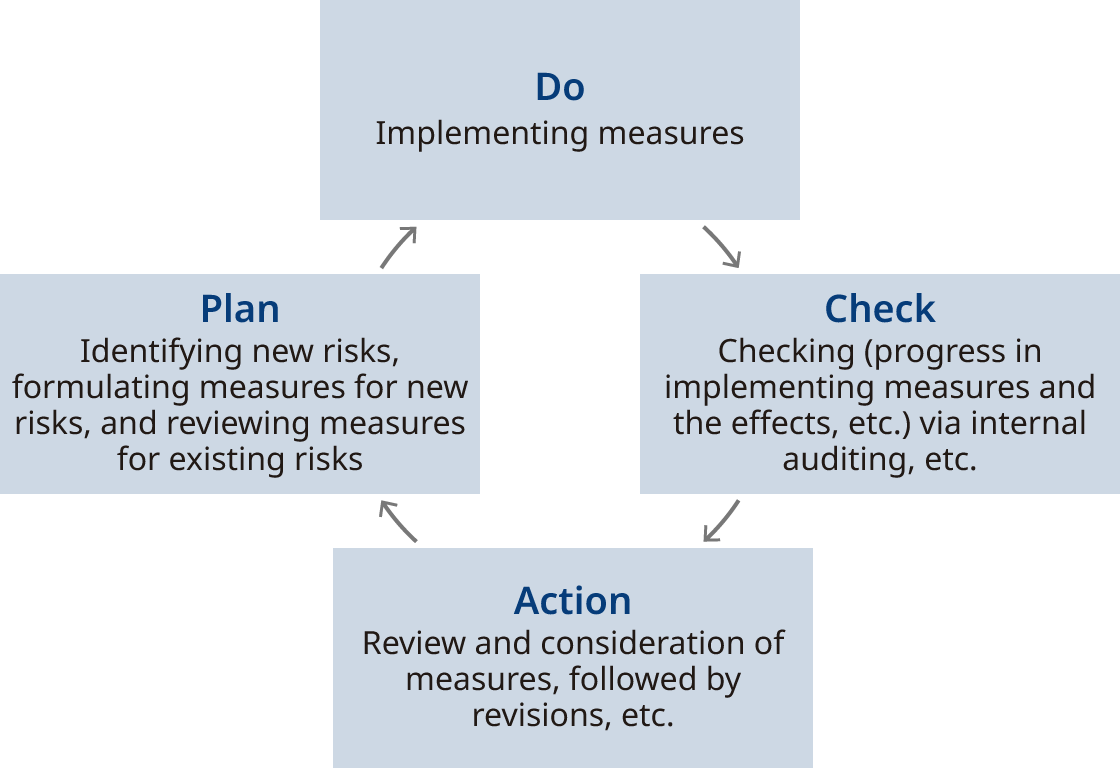
To prevent risk events, the Haseko Group is promoting risk prevention efforts, from identifying and assessing risks, formulating plans for countermeasures, and implementing risk mitigation measures, to internal auditing and reporting.
The Company seeks to continue to improve and raise its performance by using the PDCA cycle in these risk prevention efforts.
Business Continuity Plan (BCP)
The Haseko Group has formulated a Business Continuity Plan with the aim of establishing a mechanism of clarifying operations of Group companies in the event of a major earthquake and other natural disasters, ensuring the safety of housing provided by us, preventing the suspension of operations or in the event that they are suspended, enabling the resumption of operations within the shortest possible time, as well as promptly preserving offices and tasks after ensuring the safety of employees and their families, enabling employees engaged in restoration activities and restoration support to take action autonomously.
The Business Continuity Plan stipulates that it shall be triggered by the authority of the head of Group Control Headquarters in the event where large earthquakes with a seismic intensity of upper five are observed at an earthquake observation point of the Japan Meteorological Agency at the Haseko Group’s business bases (earthquakes below the reference seismic intensity are not excluded depending on the degree of the damage, etc.), and also in the event of natural disasters other than earthquakes (including storms, heavy rain, heavy snow, floods, high tides, tsunamis, eruptions, etc.) if the damage is significant. In the event of an emergency, the Company will set up a Group Control Headquarters and a Group Control and Support Headquarters in Tokyo or Osaka and a Regional Control Headquarters in the Tokai and Kyushu areas, while each Group company will set up a control headquarters.
BCP drill for natural disaster response
To ensure that the Business Continuity Plan will be promptly and properly implemented in the event of a natural disaster, the Company has made it a policy to hold a BCP drill once or more every year.
In FY2024, we confirmed the procedures for establishing the Natural Disaster Response Task Force (Teams and in-house conference room) and convening in the event of an earthquake with a seismic intensity of lower six occurring during business hours. Furthermore, all Haseko Corporation general managers held study groups in their respective departments to provide an opportunity to consider the actions that all officers and employees should take in the event of a disaster.
| (i) Drill for setting up the Natural Disaster Response Task Force | Confirmation of establishment and convening procedure for headquarters and Natural Disaster Response Task Force (in a conference room at the relevant company) using Teams |
|---|---|
| (ii) Drill for checking the situations of employees' safety | Reporting from employees on the situations of their safety, confirmation by each headquarters, etc. |
| (iii) Drill for an initial check of the situations of damage to properties from the disaster | Initial check of the Company's offices, offices at construction sites, properties relating to the Group, etc. by using a map application software |
| (iv) Drill for real-time reporting on the situations of damage from the disaster | Sharing images of sites of disaster with headquarters by using Teams |
| (v) Drill for setting support headquarters | Setting Group Control and Support Headquarters in Tokyo and Osaka, collecting and summarizing information, etc. |
| (vi) Drills by all general managers in the Group | Confirming the safety of department staff, issuing action instructions, providing operational guidance, and compiling the number of people stranded away from home Holding study sessions in each department to inform staff of earthquake disaster response guidelines and emergency response case studies |
| (vii) Compilation of the number of people stranded away from home | Reporting whether individuals are stranded and compiling the number of people stranded away from home in each headquarters |
| (viii) Confirmation of emergency supply distribution procedures | Confirming the distribution method for emergency supplies (water, food, portable toilets, etc.) at each location |
| (ix) Drill for requesting the dispatch of technical staff | Requesting the dispatch of technical staff to properties relating to the Group for emergency restoration |
| (x) Drill for staff going to the office on foot | Checking the situations of damage from the disaster in the Company's offices in the event that public transportation systems cannot be used |
| (xi) Training for technical and community support staff | Checking the buildings of elderly care centers managed by Group companies and providing support for the evacuation of residents of the centers |
Related Information
Haseko Group's Sustainability
Related Data / Integrated Report
Special Features
- Human Capital / Human Resource Development
- Diversity & Inclusion / Labor Environment
- Occupational Safety and Health / Health and Productivity Management
- Enhancing Safety and Quality in Buildings and Services
- New Value Creation
- Community
- Research and Technology Development
- Social Contribution Activities