
SEARCH
MENU
Enhancing Safety and Quality in Buildings and Services
- Basic Approach & Policy
- Structure
- Initiatives on Quality
- Initiatives on Safety and Security
- Initiatives on Customers
Basic Approach & Policy
We will realize high levels of quality and comfort so that residents can feel a greater sense of safety and security at home than anywhere else. We will also make thorough and ongoing efforts to prevent crime and disasters including preparation against earthquakes.
Haseko Corporation's Quality Policy
Providing quality that meets customers' expectations
- The Company shall accurately grasp the social needs and changes, and provide buildings that are safe, secure, and comfortable.
- The Company shall endeavor to boost customer satisfaction through integrated sales, design, construction, and after-sales services.
- The Company shall pass on the technologies and traditions it has cultivated (the Haseko DNA) through personnel development and education.
- The Company shall work with its cooperating companies to enhance quality, striving to build better.
- The Company shall make ongoing improvements to its quality management system.
Structure
Quality management system
Haseko Corporation, Haseko Reform, and Fujikensetsu have established a quality management system based on ISO 9001 and are working to improve quality by setting a quality policy.
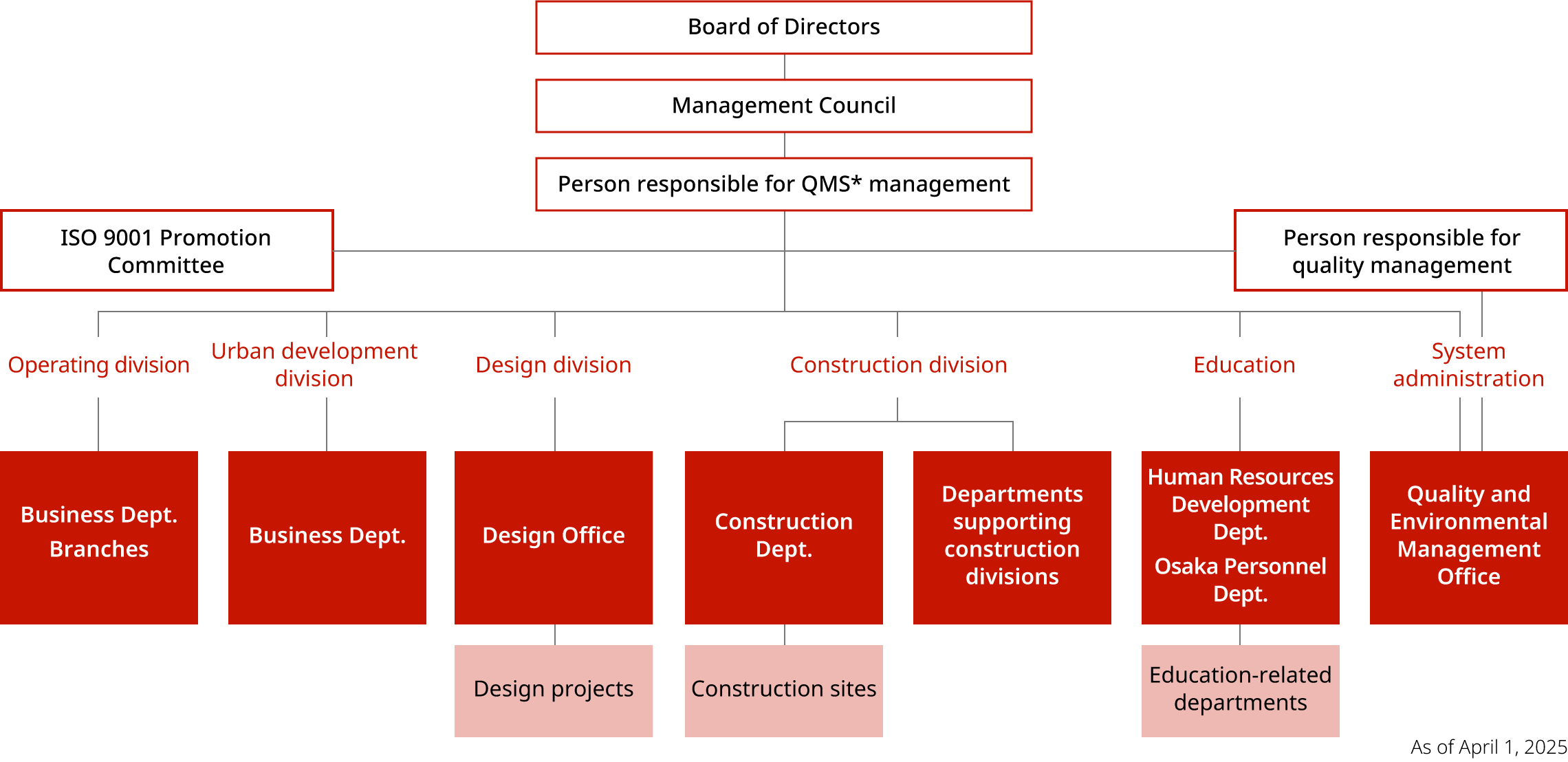
- Quality management system
Background to obtaining ISO 9001 certification
Haseko Corporation obtained ISO 9001 quality management system certification in Tokyo and Kansai regions in March 1997 and July 1997, respectively. (In March 2018, we integrated quality management systems of the two regions.) To provide consistent quality, we apply this system to all divisions involved in quality management and enhance customer satisfaction.
Divisions for which certification has been applied as of April 1, 2025 (the operating division, the Kansai operating division, the Tokai operating division, the Kansai urban development division, the construction divisions, the Kansai construction division, the design divisions, the Kansai design division).
Haseko Reform, Inc. obtained the certification in March 2014, and FUJIKENSETSU also obtained the certification in March 2000 for its Kansai Branch and November 2000 for its Tokyo Branch.
Going forward, we will continue to engage in quality management activities.
Initiatives and ongoing improvement
Upon conducting quality management activities, we formulate a quality policy, in response to which each division sets quality goals and numerical targets and carries out the activities accordingly. The quality management system is checked by internal audit and external examination as to whether or not it complies with Haseko’s determinations including specification requirements, and whether or not it is implemented and maintained properly. Based on the results, the quality management system is reviewed and improved on an ongoing basis.
The days on which external examination was conducted and the number of matters pointed out in fiscal 2024 were as follows.
| Date of registration / Renewal |
Date of external examination |
Number of matters pointed out by the external examination |
|
|---|---|---|---|
| Haseko Corporation | Mar. 31, 1997 Mar. 31, 2024 |
Dec. 17-19, 2024 | None |
| Haseko Reform | Mar. 13, 2014 Apr. 19, 2024 |
Feb. 19-21, 2025 | None |
| FUJIKENSETSU Tokyo Branch | Nov. 15, 2000 Nov. 15, 2024 |
Sep. 11-12, 2024 | None |
| FUJIKENSETSU Kansai Branch | Mar. 1, 2000 Mar. 1, 2024 |
Nov. 14-15, 2024 | None |
Initiatives on Quality
Formulation and implementation of quality standards
Haseko Corporation has accumulated tremendous know-how concerning how to construct condominiums to heighten customer satisfaction from its experience of building over 700,000 condominium units. We have collected know-how to create unique quality assurance standards and apply these standards to all condominiums we design and construct. Our unique quality assurance standards include ths Design Guidelines, which form our standards for design, and the Standard Plans, which summarize detailed construction methods. The standards are shared among our technical divisions.
We continue to hold meetings across the Architecture & Engineering, Construction, and Technological Promotion Divisions to share real feedback from condominium residents, information from condominium refurbishment & maintenance management companies, and “construction information from construction sites” gathered by Haseko Corporation and Group companies. Any matters requiring action are communicated to departments through the relevant meeting body, standards are added, revised, or improved, and periodically reflected and disseminated through the Design Guidelines and the Standard Plans, to continually improve quality.
Quality education
As a company that provides safe and secure homes for our customers, Haseko Corporation develops and implements an education and training curriculum each fiscal year for all personnel engaged in activities that affect quality, based on the ISO 9001 standard.
We especially promote measures to encourage employees to obtain technical qualifications, such as first-class registered architect qualifications and first-class construction managing engineer qualifications, which include the acquisition of important knowledge for ensuring quality. We also annually train internal quality auditors from the construction, design, and technology promotion divisions, and strive to develop personnel capable of auditing from a customer standpoint and perspective.
Quality management in the supply chain
Quality education for suppliers (partner companies)
Haseko Corporation, together with Ken-ei-kai, an organization of main partner companies, is engaged in value enhancement activities to provide high-quality condominiums. As part of these efforts, our construction quality improvement division also helps partner companies provide quality education.
Specifically, the Tokyo construction quality improvement division holds annual expanded workshops for employees of all partner companies working on our construction sites, in addition to corporate members of Ken-ei-kai. At the workshops, we explain the issues indicated and points to be noted from previous completion inspections, as well as issues to be kept in mind during construction works, to the various subcommittees: the Building Frame Subcommittee, the Facilities Subcommittee, the External Structures Subcommittee, the Interior Works Subcommittee, and the Exterior Works Subcommittee. After the workshops, we accept questions, suggestions, and requests. Considering and replying to them provides opportunities for improvement. In addition, Ken-ei-kai members carry out monthly on-site patrols to check the thorough implementation of points to be noted and provide guidance, as well as to hear feedback from workers on-site and identify issues requiring consideration. (The session in FY2024 was attended by 2,813 people.)
A Debriefing Session on Value Enhancement Activities is also held once a year to spread knowledge of the status and results of all value enhancement activities. Timely themes are selected for the sessions, and they introduce the employees of all partner companies and construction workers working on our construction sites to the content of value enhancement activities undertaken over the past year. (The session in FY2024 was attended by 3,147 people.)
We are undertaking similar initiatives in Kansai and Tokai regions as well.
Continuous evaluation of suppliers (partner companies)
We engage in the continuing assessment of partner companies to accurately grasp their capabilities and facilitate guidance and education. Specifically, we assess all primary partner companies* at each construction site regarding aspects such as quality management, safety and health management, environmental management, process management, and cost management, on the completion of each construction. In cases where we consider improvement necessary, we request them to make improvements while implementing education as required.
In addition, in order to fulfill its social responsibility across the entire supply chain, the Haseko Group requests its business partners to comply with the Haseko Group Sustainable Procurement Guidelines, which include matters regarding securing quality, obtains written consent from its main business partners, and regularly verifies their compliance through questionnaires using a self-checklist.
- Primary partner companies: Partner companies with a direct contractual relationship with Haseko Corporation.
Audit of supplier's factories
For materials related to the structure, etc., especially those that assumed to have quality risks, of buildings, we work to ensure quality by auditing suppliers' factories, in addition to conducting receiving inspections at construction sites and other measures. In the audits, HASEKO Corporation technical division employees check the factories' quality control system and their actual operations, according to the checklist. We implement these factory audits when considering the adoption of new materials from such factories, and on a regular basis according to the risks by material type.
The factories to be audited include those of upstream suppliers, not limited to those of suppliers contracted directly by HASEKO Corporation, as distribution channels vary depending on the type of material.
Initiatives on Safety and Security
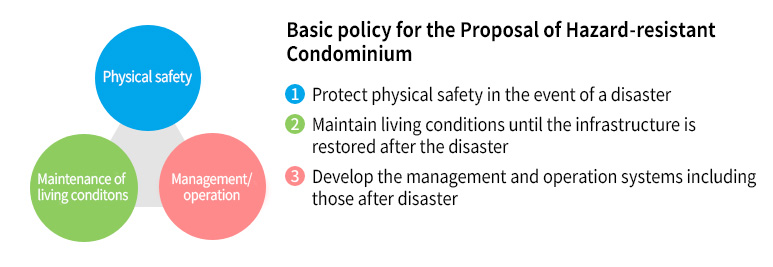
Providing services under the Proposal of Hazard-resistant Condominium
The Disaster Resilient Technology Working Group, which was established by the Haseko Group in the wake of increasingly severe natural disasters, has prepared and has been providing services based on the Proposal of Hazard-resistant Condominium covering exclusive and communal areas, essential services, as well as operation and management.
The Proposal will be actively made to properties inside and outside the Group for adoption to support residents both from the tangible and intangible aspects of the Haseko Group’s safe, secure, and comfortable condominiums leveraging the advantages of collective living.
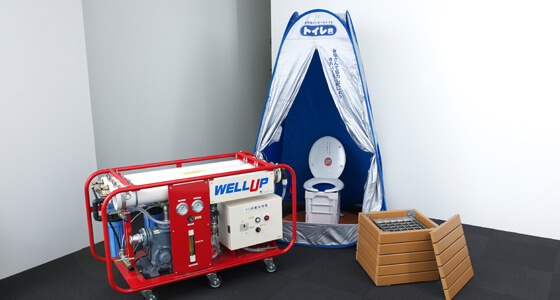
Haseko's Three-Item Disaster Preparedness Set to secure post-disaster living necessities
The Haseko Group has long believed that it is important to not only ensure the basic performance of condominiums per se, but also develop the framework to secure the basic necessities of life for residents after a disaster has occurred. From such perspective, we became the first in Japan to adopt an emergency potable water generation system in a for-sale condominium in 2003, and have since been putting efforts into adopting and proposing the Three-Item Disaster Preparedness Set —which consists of an emergency potable water generation system, emergency manhole toilets, and benches that convert into cooking stoves as disaster prevention equipment to secure post-disaster living foundation, i.e., water, toilets and fire—in for-sale condominiums designed and constructed by us.
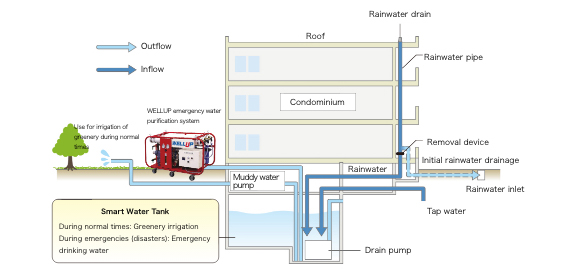
Development and introduction of the Smart Water Tank that utilizes rainwater efficiently
Haseko Corporation and Haseko Property Management Holdings have developed the Smart Water Tank as a disaster prevention and environmentally-friendly initiative and pushed forward with the adoption of the product to the Group’s for-sale condominiums. This facility stores rainwater taken from the condominium roof and makes efficient use of the stored rainwater for watering plants during normal times to help preserve water resources, and in emergency situations, it can supply drinking water to residents for six days (three liters per person per day) by using the WELLUP emergency water purification system. In the future, we plan to install the Smart Water Tank as a standard specification for projects of over 200 units designed and built by Haseko Corporation.
Seismic reinforcement of condominiums currently housing residents
Development of Haseko Non-brace Reinforcement Frame Method
Existing condominiums with concerns over anti-seismic performance often have difficulty in obtaining seismic diagnosis and reinforcement work due to reasons such as no budget for reinforcement work, no budget for diagnosis fees, lack of interest in seismic diagnosis, and lack of interest due to increasingly aging residents (source: “Survey Results of Current Condition of Condominiums,” by the Bureau of Urban Development, Tokyo Metropolitan Government, March 2013). In addition to the Haseko Group’s existing earthquake resistance initiatives, such as aseismic capacity evaluation, repair and design, and construction work, we continue to develop technology that allows condominium residents to continue to live in their units while the units are being refurbished with aseismic features. One such technology we have developed is the unique, aseismic reinforcement Haseko Non-brace Reinforcement Frame Method, a construction method that does not compromise the view from condominium units and allows residents to continue to reside in them while construction takes place.
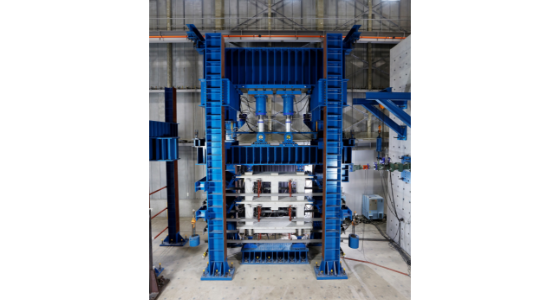
This seismic reinforcing method does not use diagonal braces that may obstruct the view but instead uses reinforcing intermediate columns, which allows reinforcing effects to be adjusted. Also, installing reinforcing frames consisting of wide flat beams, reinforcement columns, and reinforcing intermediate columns increases seismic capacity. Furthermore, although conditions apply, the reinforcement frames can be installed in middle floors, foregoing ground installations of newly installed frames as required in existing methods.
In the future, we will make the Haseko Non-brace Reinforcement Frame Method widely known as an option for existing condominiums which need to be reinforced for earthquake resistance and proactively make proposals combining other seismic reinforcement methods that are optimal for individual situations and requests.
Benefits of the Haseko Non-brace Reinforcement Frame Method
- The view from the balcony is less compromised
- Work is possible while residents continue to live there as in-unit work is not required
- Lower cost than other existing reinforcement methods
- Environmentally-friendly method as demolition and removal of existing buildings are kept to a minimum
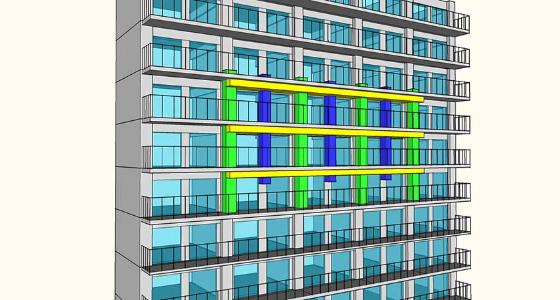
(Wide flat beams (yellow), reinforcement columns (green), reinforcing intermediate columns (blue))
Development of the new 2V-SPEC method for drainage riser renovation
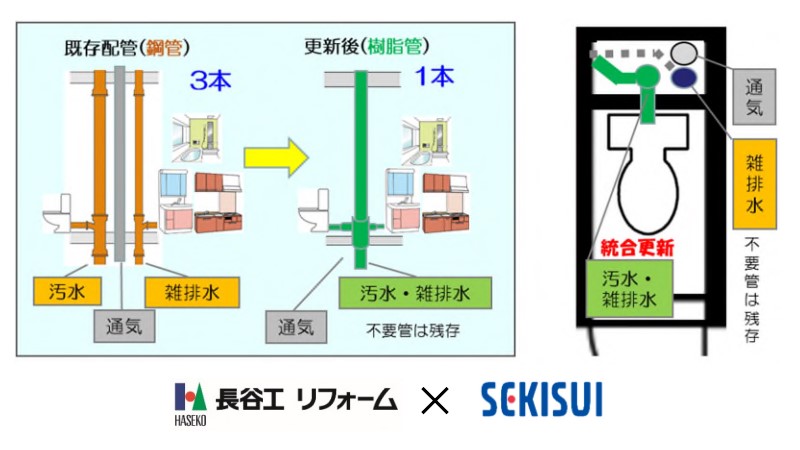
With technical support from SEKISUI CHEMICAL, Haseko Reform developed the new 2V-SPEC method*1 for drainage riser renovation in condominiums.
There has been an increasing demand for renovation of condominiums built in the 1970s and 1980s due to increased leaks in drainage risers associated with deterioration of facilities. Furthermore, the mainstream method for drainage facilities at the time was the two-pipeline ventilation and drainage method*2, which utilized three risers consisting of a sewage pipe, a gray water pipe, and a ventilation pipe.
The recently developed 2V-SPEC method is a renovation method that uses a special drainage coupler*3 to connect the existing sewage pipe and gray water pipe to a single newly installed fire-resistant rigid polyvinyl chloride (PVC) pipe. Simultaneously integrating and renovating the sewage pipe and gray water pipe can be expected to reduce not only initial renovation costs, but also long-term life cycle costs.
- 2V-SPEC method: A method containing the two meanings of “Two-pipeline Ventilation - SPEcial Coupler of renewal drainage system” and “Two-Value SPEC of renewal drainage system.
- Two-pipeline ventilation and drainage method: A method that uses existing couplers (DV couplers) and uses separate risers for sewage and gray water.
- Special drainage coupler: A coupler that allows both sewage and gray water to be connected to a single riser, with no need to increase the riser diameter. The internal vanes installed within the coupler cause the wastewater to swirl, creating an air column within the pipe and eliminating the need for a ventilation pipe. This type of coupling has been used for more than 30 years in newly constructed housing complexes.
Benefits of the 2V-SPEC method
- Significantly reduces materials, labor, and waste generated during renovation work → Reduced up to 65%
- Reduces cost by improving the efficiency of renovation work → Reduced up to 35%
- Reduces burden on residents during the renovation work period → Noise and vibration reduced up to 65%, period required to stay at home reduced from 4 days to as little as 2 days
- Reduces CO2 emissions associated with material manufacturing, waste material processing, and transportation → Reduced up to 65%
- Each reduction value is the maximum expected value.
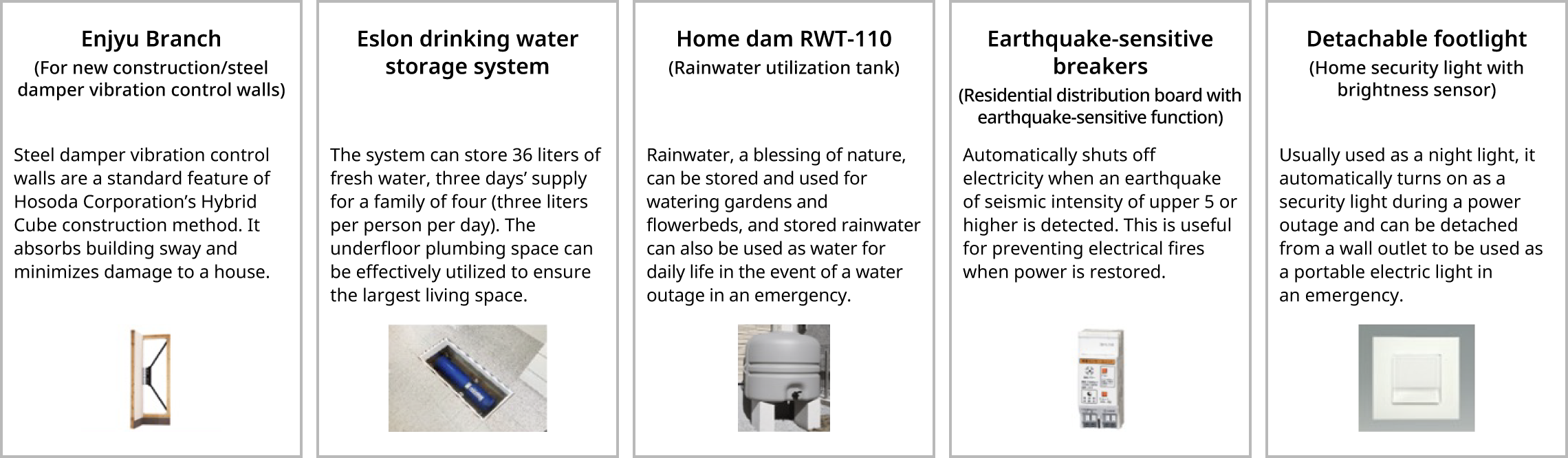
Disaster preparedness for detached housing: Hosoda Corporation’s disaster preparation kit proposal
Hosoda Corporation proposes the adoption of a five-piece disaster prevention equipment set to support the securing of lifelines in the event of an emergency in for-sale new detached houses and to customers who are remodeling their own houses.
Initiatives on Customers
Haseko's Premium After-Sales Service
After-sales service for perpetual and comfortable residency
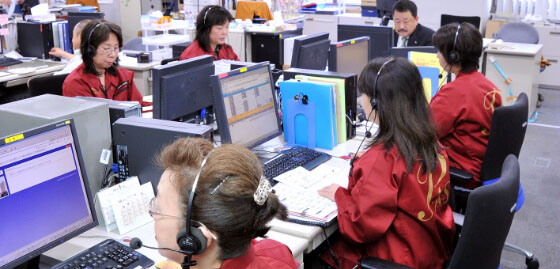
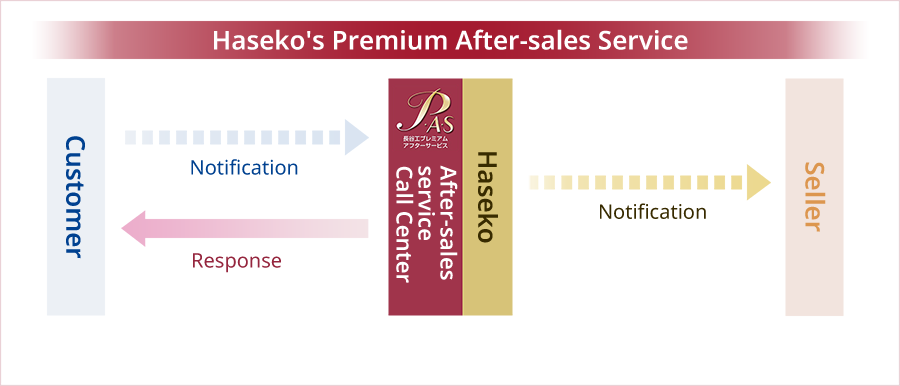
Haseko Corporation has treated after-sales service as an important quality of condominiums. In 2008, we thus introduced Haseko’s Premium After-Sales Service (PAS) to get a grasp of the status of condominiums more accurately and take optimal action in a speedy manner by listening to our customers’ opinions directly. To date, this service has been provided for 111,219 units. A total of 12,001 cases were handled in FY2024, with 8,905 from the Tokyo region and 3,096 from the Kansai region.
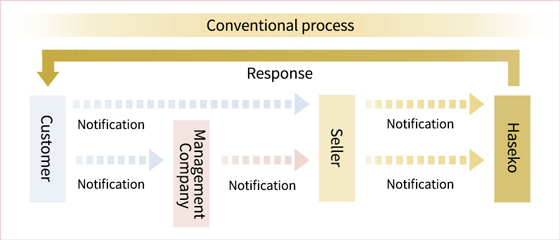
Back in the day, the common procedure was to receive a call via a condominium management company. With the introduction of PAS, customers' opinions are communicated directly to Haseko (i.e., the builder), allowing first-class registered architects and other staff with expert knowledge of condominiums to respond and thereby facilitate technicians' actions.
PAS not only serves as a call center, but also provides support from all angles so that the home can be used for a longer period of time, including the extension of the after-sales service period, the enhancement of periodic services, and the distribution of Maintenance Handbook for Housing and Tool Kit for Maintenance. Furthermore, comments received at the call center and results of periodic inspections by the inspection team are shared at feedback meetings attended by the design, construction, and technological promotion divisions as well as the management companies. They are also reflected in properties undergoing design and construction. We hope to contribute to the safe and secure living of residents by adopting PAS in more properties in the future.
After-sales service by Hosoda Corporation
Hosoda Corporation, which has strived to provide safe, secure, and comfortable housing for many years, provides a guarantee of up to 60 years under its built-to-order free plan.
The initial guarantee period for foundations, structural framework, and waterproofing is 30 years. This period may be extended for a further 10 years pursuant to an inspection and paid maintenance works carried out in the 30th year. Thereafter, the guarantee period may be further extended to a maximum of 60 years (in combination with the initial guarantee period) by performing inspections and paid maintenance works every 10 years for foundations, structural framework, and waterproofing, and every 5 years for pest prevention.

Community Owl 24 Center:
Defending home safety and security around the clock, 365 days a year
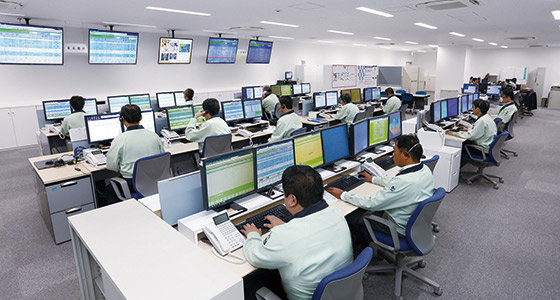
Haseko Community Owl 24 Center, a comprehensive monitoring center owned by Haseko Community, monitors alarms of condominiums 24 hours a day, 365 days a year. In the event of an emergency situation, the Center will receive an automatically-forwarded alarm or a telephone call from a resident, promptly get a grasp of the situation and dispatch security staff. The Center also serves as an out-of-hours point of contact by telephone.
Related Information
Haseko Group's Sustainability
Related Data / Integrated Report
Special Features
- Human Capital / Human Resource Development
- Diversity & Inclusion / Labor Environment
- Occupational Safety and Health / Health and Productivity Management
- Enhancing Safety and Quality in Buildings and Services
- New Value Creation
- Community
- Research and Technology Development
- Social Contribution Activities