
SEARCH
MENU
Message from the Officer in Charge of Sustainability Promotion

Basic approach to sustainability management
The HASEKO Evolution Plan medium-term business plan (FY2025 to FY2030) that commenced in April 2025 places sustainability management at the core of value creation.
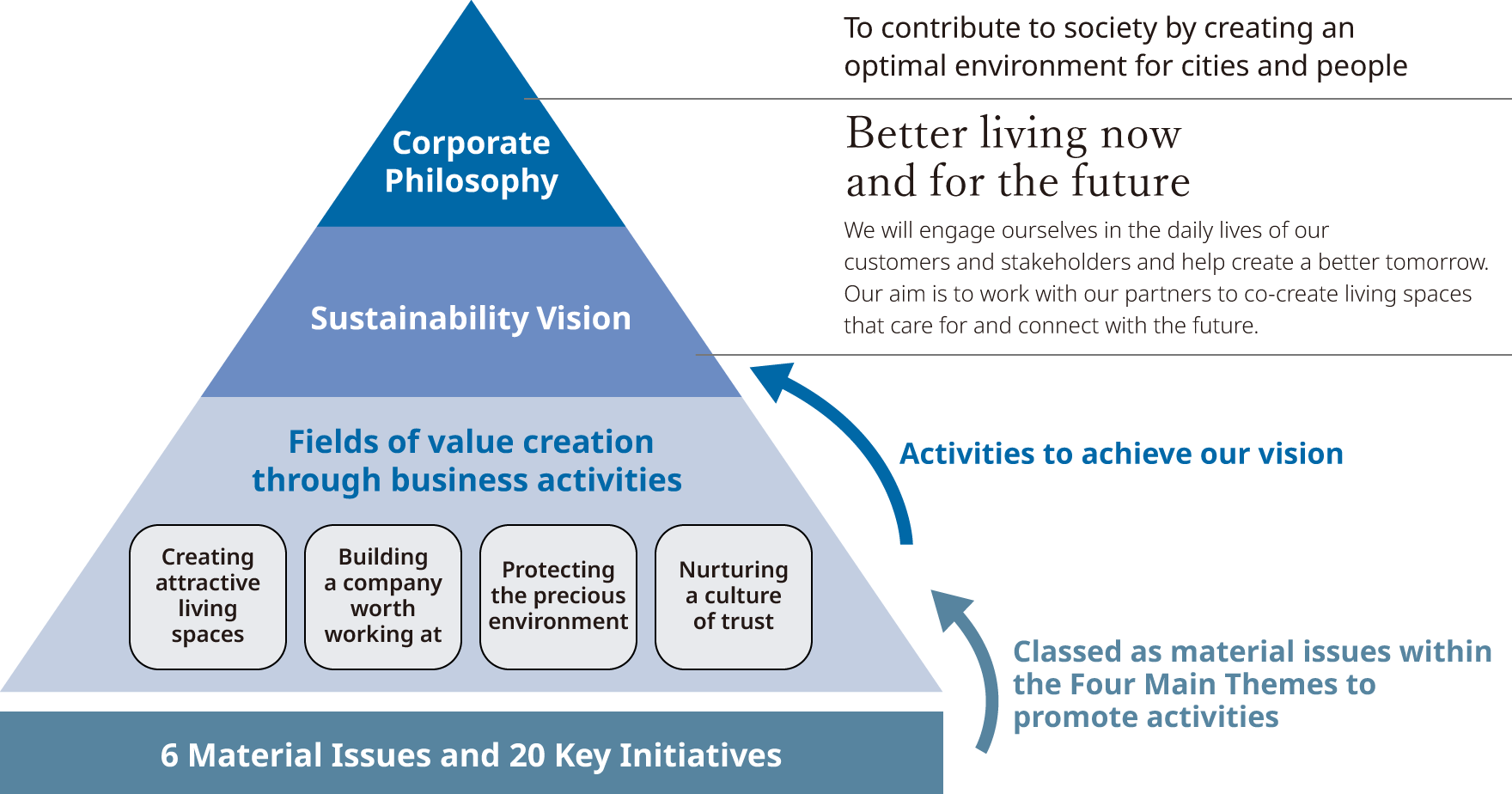
Haseko Corporation’s Corporate Philosophy is “To contribute to society by creating an optimal environment for cities and people,” and we have a Sustainability Vision geared to making this a reality. Under our Corporate Philosophy and Sustainability Vision, we aim to find solutions to the issues faced by society that affect living through our business as a leading company in housing and living. The HASEKO Evolution Plan sets out [Succession x Change = Evolution] as the direction that we are aiming to take, and now, in the second year of this plan, we will take the evolution and deepening of our sustainability management to the next level.
Progress in the first year of the HASEKO Evolution Plan
In the first year, we set reconstruction of the sustainability promotion system and enhancement of information communication and disclosure as our priority focus. As part of this, since FY2025 we have incorporated a corporate value improvement coefficient that reflects non-financial indicators and capital efficiency metrics in the formula for calculating performance-linked remuneration (share awards) of directors and other officers in order to increase the commitment at the executive level (see p.71). Furthermore, in April 2026 we established the new Integrated Disclosure Promotion Office, thus putting in place a system under which I, the officer in charge of sustainability promotion, can oversee all aspects of disclosure. We are currently working to establish deeper connections with group companies and divisions, and on enhancing monitoring of non-financial KPIs and progress management.
The aim of launching the Integrated Disclosure Promotion Office was to enhance our disclosure framework ahead of the application of SSBJ standards* and to strengthen our integrated communication capabilities for financial and non-financial information. For environment-related information, we have continued to undertake disclosure in line with both TCFD and TNFD recommendations, and have worked to reduce CO2 emissions under our SBTi-validated targets. While progress is mainly as planned in terms of our main KPIs relating to human capital, human rights, and the supply chain, reducing CO2 emissions (including Scope 3 emissions) is a medium- to long-term challenge for us, so we will continue to enhance our initiatives across our supply chain as a whole.
- We plan to apply these standards from FY2028
Review of material issues and their significance
In July 2026, we reviewed and published our material issues. This revision was prompted by insights gained through our dialogue with investors. This ongoing dialogue gave me a firm understanding of their expectation for us to create a story that goes beyond merely enhancing disclosure and depicts the kind of social value we will produce through our business activities. In order to meet demands for linking our material issues to ROIC and KPIs and for integration in the value creation process, we overhauled our process for identifying material issues and ensured that the will of our top leadership was deeply woven into all aspects of material issues by undertaking interviews with the president and questionnaire survey of directors (and other officers) and those at the executive and management levels at group companies. This also represents a switch from our passive approach of meeting the demands of society to a proactive approach of providing value to society through our business.
Six material issues were identified - Living and the Built Environment / Climate Change / Resources and Nature / Human Capital / Human Rights and Labor / Trust and Foundations - as well as 20 key initiatives, and all of these flow from our Corporate Philosophy and Sustainability Vision. Each one is set out in a concrete form in our fields of value creation that are composed of our Four Main Themes: creating attractive living spaces, building a company worth working at, protecting the precious environment, and nurturing a culture of trust.
Our new material issues focus our initiatives on areas that fit with our growth story, and fulfill the role of a compass to guide management decision-making. Among these issues, the one that most embodies the essence of Haseko Corporation is living and the built environment. Through our business activities in this field, we will provide a wide range of value in the form of safety and security for residents, comfort, diversity, and community formation.
In light of this review of material issues, we are also considering whether or not our Sustainability Vision should also be rethought in the near future. I see my own duty as being to incorporate the expectations and issues that our dialogue with stakeholders revealed into our management strategy, and to carefully convey our progress in addressing these matters. At the same time, as the officer in charge of sustainability promotion I also see creating an environment in which each and every employee can discover where their work fits in with sustainability as an important role of mine.
Promotion of the Sustainability Action Plan
We are following our Haseko Group Sustainability Action Plan as a mechanism for action on the 6 Material Issues and 20 Key Initiatives. This plan takes the aforementioned four areas of value creation as its basic composition, and comprises initiatives toward our vision for 2037 (our centenary) set out for each area as well as KPIs to measure the level of achievement of their goals. Building in the business activities of the Group as a whole and going through a process of reviews and improvements each fiscal year, we will steadily put this plan into practice while also working to make progress on it visible.
To open up the future of housing and living
The condominiums and other housing and buildings that Haseko Corporation builds are not completed at the moment they are handed over; their value is nurtured through their use and by people living in them over the course of several decades. By its nature, the business in which the Haseko Group is involved brings with it long-term responsibility, and requires the production of value that lasts over generations. I see sustainability management as the natural form that management is led to by the unique characteristics of this business.
Furthermore, effectiveness in sustainability management is not something that Haseko Corporation can achieve by itself. As a company that engages in business alongside a variety of cooperating companies and business partners in processes spanning everything from design and construction to sales, brokerage, and management, dialogue and co-creation with the partners that constitute our supply chain are absolutely essential. While working toward deeper cooperation with group companies, local communities, and government, we will advance our initiatives with a view to contributing to increasing sustainability in the industry as a whole. I recognize this as being another of the responsibilities that we have to fulfill.
February of 2027 will mark the 90th anniversary of the founding of Haseko Corporation. Our brand message of “We consider more.” reflects the fact that we consider all stakeholders from the past, the present, and those in the future, and in line with this, we hope to work together with all of our stakeholders to open up a sustainable future through a process of dialogue. We take the responsibility given to us by society for the future of housing and living very seriously, and will continue to fulfill this responsibility going forward.
- This message is reproduced from the Sustainability Promotion Officer's Message in the Integrated Report published in October 2026.
Haseko Group's Sustainability
Related Data / Integrated Report
Special Features
- Human Capital / Human Resource Development
- Diversity & Inclusion / Labor Environment
- Occupational Safety and Health / Health and Productivity Management
- Enhancing Safety and Quality in Buildings and Services
- New Value Creation
- Community
- Research and Technology Development
- Social Contribution Activities