
SEARCH
MENU
Diversity & Inclusion / Labor Environment
- Diversity & Inclusion
- Basic Approach & Policy
- Initiative Targets
- Initiatives
- Building a Pleasant Working Environment (Labor Environment)
- Basic Approach & Policy
- Initiative Targets
- Initiatives
Diversity & Inclusion: Basic Approach & Policy
We will work to build an environment and structure that allow employees from a diverse range of backgrounds to reach their full potential with a focus we describe as “getting the most out of their qualities.”
Haseko Group Diversity & Inclusion Promotion Policy
The source of the Haseko Group’s competitiveness is our diverse human resources drawn from a diverse range of professional backgrounds. These human resources share with one another their ideas on “housing to create great living” which the Company then draws upon to create a unique business model.
Each and every employee of the Haseko Group remains committed to putting into practice the five points of the Group’s Principles of Conduct* all the while retaining focus on the goal of further enhancing corporate value through the demonstration of diverse sets of values, ways of thinking, individual characteristics, and capabilities that recognize no boundaries in terms of race, nationality, gender, sexual orientation, gender identity, age, religion, or disability, with “getting the most out of their qualities” as a key theme.
What the Company Aims to Be
- To promote the development of an environment which can adapt to on-going social changes and in which each and every employee can achieve genuine satisfaction in their work.
- To take the idea born out of collaboration between the Group’s diverse human resources and to tie it to the creation of added value in terms of living and lifestyle that the Haseko Group provides.
- To improve the Group working environment, including by helping employees find a balance between work and family, and to expand our workplaces and business areas as places in which employees can thrive so as to ensure continued diversity in our human resources.
Established: April 14, 2023
Partial amendment as of June 29, 2023
Initiative Targets
◎: KPIs in the HASEKO Evolution Plan medium-term business plan
| Metrics | Targets |
|---|---|
| Percentage of women among new graduates hired* | 30% |
| Percentage of female employees | 30% or more |
| ◎Percentage of female managers | 12% (FY2030) |
| Percentage of male workers using the childcare participation system* | 100% |
| Percentage of childcare leave taken by male workers | 50% |
| Percentage of disabled persons employed | 2.5% |
- The childcare participation system refers to childcare leave and spousal childbirth leave
For the results, please refer to the ESG data.
Initiatives
Active participation of diverse employees
Employees with diverse backgrounds work at the Haseko Group and its cooperating companies. We intend to build environments and systems that will enable this workforce to display their abilities to the fully demonstrate their abilities.
| Active participation of individuals |
|
|---|---|
| Active participation of women |
|
| Support for active participation of people with disabilities |
|
| Active participation of foreign human resources |
|
| Active participation of senior personnel |
|
Supporting the active participation of women
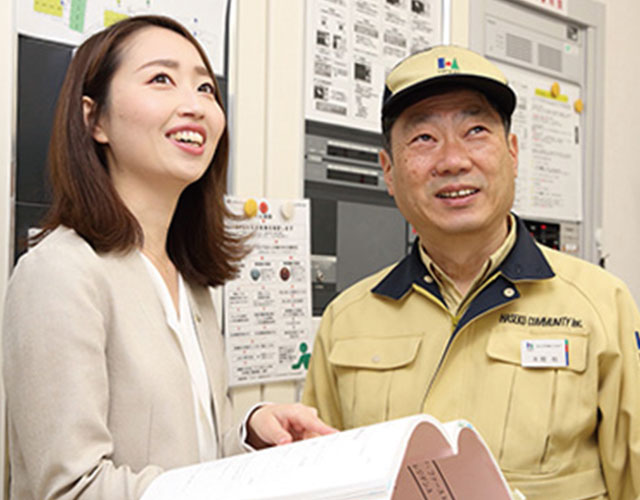
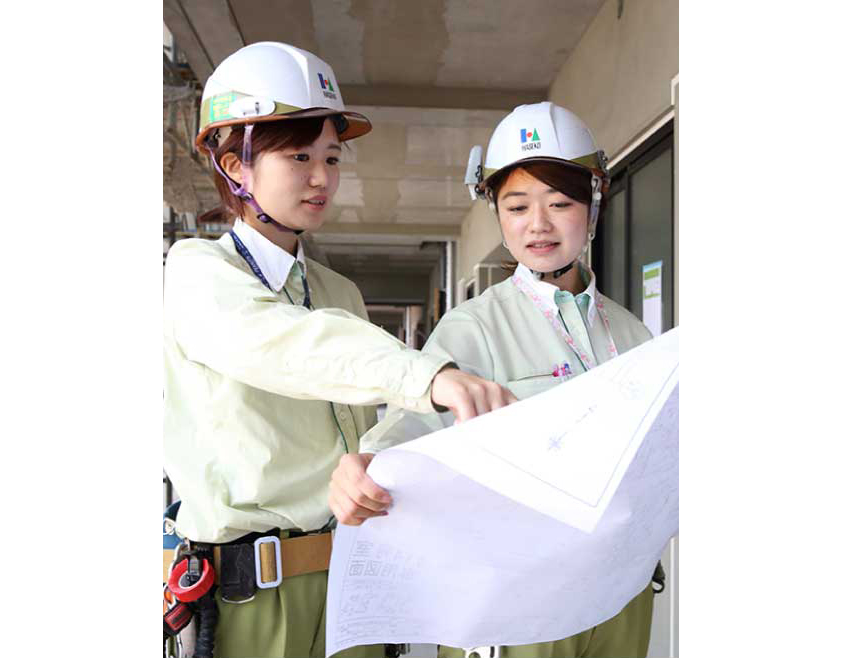
The Haseko Group aims to provide fair opportunities for all employees to flourish, regardless of gender.
On the basis of both the Act on Promotion of Women’s Participation and Advancement in the Workplace and the Act on Advancement of Measures to Support Raising Next-Generation Children, Haseko Corporation has formulated and published the General Employer Action Plan set out below. We aim to put in place a working environment that enables women to work to their full potential over the long term, and create a workplace that is pleasant for everyone.

General Employer Action Plan of Haseko Corporation based on the Act on Advancement of Measures to Support Raising Next-Generation Children and the Act on the Promotion of Women's Active Engagement in Professional Life
Haseko Corporation shall formulate the following action plan to develop a working environment in which everyone can fully demonstrate their abilities, through the promotion of women’s active participation and the enhancement of systems to support work-life balance.
General Employer Action Plan of Haseko Corporation
Period of the plan
April 1, 2025 to March 31, 2028
Details
Target 1: Achieve a 5.5% ratio of female managers by the end of fiscal 2027.
Initiatives
- Organize the standards for appointing managers and appoint them based on ability and degree of contribution.
- Support career-building by connecting women colleagues and through exchanges with diverse role models.
- In addition to promoting the development of female management candidates, proactively nominate women to attend selective training programs.
Target 2: Achieve a female hiring ratio of 30% or higher.
Initiatives
- Set a target ratio of women among new graduates hired and proactively hire women.
- Enhance the special website for new graduates to hire female students in technical fields, while also increasing the number of site tours to locations where women work as well as the opportunities to meet with female employees.
Target 3: Ensure that average statutory overtime and holiday work hours are less than 45 hours per month.
Initiatives
- Implement initiatives to address the issue of long working hours, such as activities to improve productivity (MOSt Activities).
- Enhance the systems that support work-life balance while encouraging employees to utilize them, and operate the systems appropriately based on the nature of employees’ work and actual workplace conditions.
- Promote a balanced work style by planning systems that facilitate taking leave and by fostering a culture that encourages employees to take leave.
Target 4: Achieve a 100% utilization rate of the male employee childcare participation program (childcare leave and spouse maternity leave).
Initiatives
- Plan systems and implement initiatives to promote the taking of childcare leave.
- Carry out community-building for employees eligible for childcare leave.
Group-wide efforts to promote women’s active participation
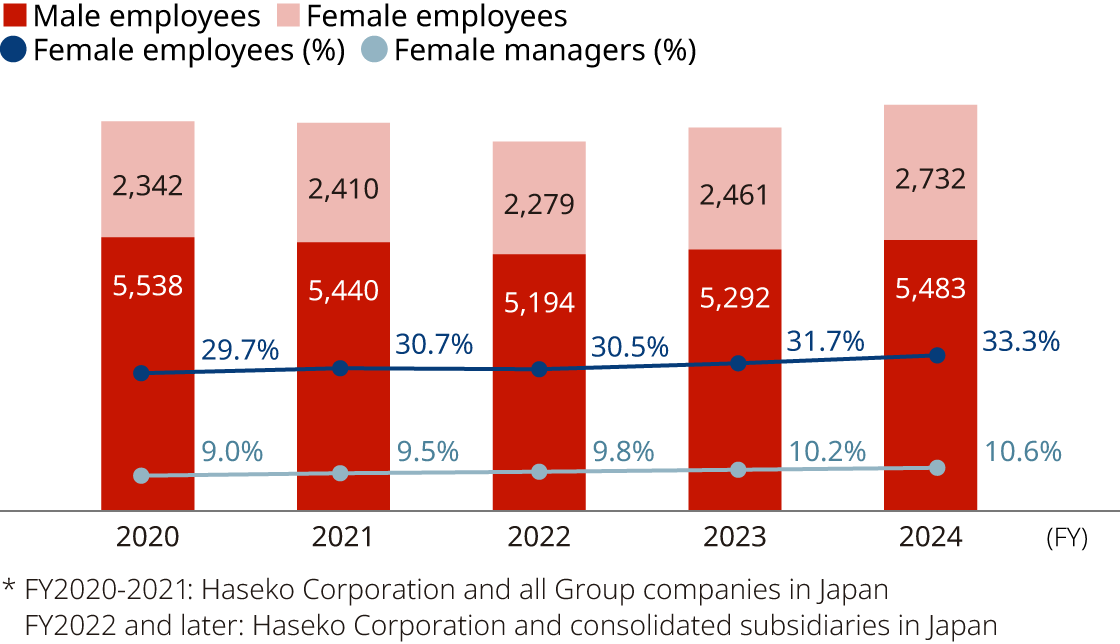
The Haseko Group has proactively promoted the appointment of female ahead of the industry. Currently, our female employees play active roles in all fields of work in condominium life making, ranging from business planning, development promotion, design, construction, sales, and interior decorating to administration.
The Group has implemented a variety of retention measures to raise the percentage of female employees, which include active recruitment of female employees, gathering of female employees, training for female employees, and follow programs for pre- and post-childbirth and childcare leave. Going forward, we will continue focusing on the development of the Company’s core employees and actively promoting the appointment of female toward the target of raising the current percentage of female managers.
Networking events for women based on job type
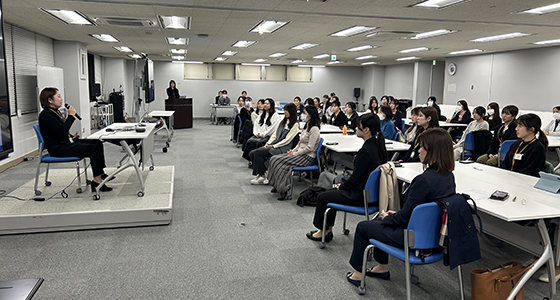
We are implementing training and staff exchange meetings at different companies and divisions in the Haseko Group with the aim of enabling women’s network building and solving workstyle and workplace environment issues to “create a workplace environment where women can enjoy a long career.” These provide opportunities to expand the network of female colleagues and discover a variety of role models, while also offering the chance to consider careers and providing a place to obtain a sense of security in terms of work.
External evaluations and awards
Kurumin certification acquired
Six Haseko Group companies acquired certification by the Minister of Health, Labour and Welfare (Kurumin certification) on the basis of the Act on Advancement of Measures to Support Raising Next-Generation Children in FY2025.
- Haseko Corporation
- Haseko Real Estate Development Holdings
- Haseko Real Estate Development
- Sohgoh Real Estate
- Haseko Real Estate
- Haseko Senior Well Design
Eruboshi Certification acquired
The Eruboshi Certification system was implemented pursuant to the Act on Promotion of Women’s Participation and Advancement in the Workplace.
In 2024, Haseko Corporation satisfied all five evaluation standards in the Ministry of Health, Labour and Welfare’s Eruboshi Certification system and attained the highest certification possible of 3 stars (Stage 3 certification). The five standards are employment of women, length of continuous employment, working hours and other work style-related matters, proportion of women in management, and diversity of career paths.
In addition, within the Haseko Group, Haseko Senior Well Design received a 3 stars, while Haseko Reform received a 2 stars (Stage 2 certification).
Selected as a Nadeshiko Brand in FY2022
Haseko Corporation has been selected as one of the Nadeshiko Brand for FY2022 by the Ministry of Economy, Trade and Industry in cooperation with the Tokyo Stock Exchange as a listed company that excels in the promotion of women’s activities.
Systems to support work-life balance
Support for balancing work with childcare and nursing care
Aiming for a working environment where employees can actively work in their own way alongside life events such as childbirth, childcare, and nursing care, we make efforts to reinforce a system to support work-life balance and encourage them to use it.
The framework of childcare leave and shortened work hours is maintained at a higher level than those stipulated in legal standards so that employees can take childcare leave until their children reach three years old, and shortened work hours until their children reach the third grade of elementary school. In addition, we provide opportunities for employees to have interviews with HR staff before, during, and after childcare leave to eliminate their concerns during leave and follow up on their future careers. At the interviews, we explain our systems and procedures related to childcare leave and other internal programs, listen to employees’ vision of their workstyle after returning to work, and maintain an environment for sharing corporate updates during leave.
In April 2019, we reinforced systems for balancing work and family by newly establishing and implementing our own systems: “children leave” which enables employees to take a 10-day paid leave per child (under three years old) for childcare purposes; “spouse maternity leave” which enables male employees to take one-day paid leave to attend delivery by their spouses; and “hourly annual leave” which enables employees to take annual leave on an hourly basis equivalent to up to five days per year.
Furthermore, in order to encourage men to participate in raising their children, we are working to achieve a 100% utilization rate of the male employee childcare participation program (childcare leave and spouse maternity leave).
In April 2024, we changed the nursing care system to help employees balance work with nursing care. Employees can now take nursing care leave in installments within a total period of one year, and take 50 days a year of leave for each family member under care. In conjunction, we established a Nursing Care Portal Site for employees and strengthened support systems by centralizing information on nursing care and establishing a consultation service.
Going forward, in addition to disseminating information through our company newsletter and internal portal site, we will promote understanding and utilization of these systems by providing individualized explanations and conducting interviews to understand employees’ intentions to use them, thereby contributing to the creation of a comfortable and supportive working environment.
Main systems and initiatives
- Childcare leave system (up to 3 years old)
- Partially paid spousal childbirth leave and childcare leave
- Time off for children’s events and shortened work hours system (until the third grade of elementary school)
- Nursing care leave system (leave can be taken in installments within a total period of one year)
- Nursing care leave system (50 days a year for each family member under care)
- Annual leave in hourly units, work-from-home, staggered commuting
- Job category transfer system, reemployment system
- Iku-Boss* Declaration, Declaration, introduction of actual cases in the company newsletter, etc.
- A term combining childcare and boss, which means a boss who supports work-life balance and career development
For the results on usage of each system and other such matters, please refer to the ESG data.
Promoting employment of persons with disabilities
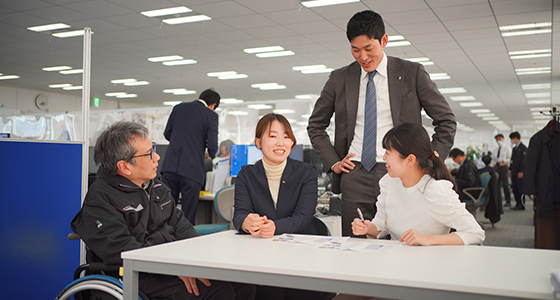
The Haseko Group is continuously working to encourage the employment of persons with disabilities with the aim of realizing a workplace where persons with or without disabilities work together.
Haseko Corporation established Haseko Systems (now HASEKO Links) in 1991 as a special subsidiary and obtained certification under the “related companies special system (group application)” in 2009. As of June 1, 2025, our employment rate of persons with disabilities is 2.54%.
Initiatives at HASEKO Links
Established in 1991, HASEKO Links engages in a variety of businesses including office services, storage, digital solutions, rental and leasing, and insurance services under the slogan “Contribute to society while able-bodied people and persons with disabilities work together.”
In 2017, the subsidiary started the rental farms of Kashiwa Farm and Funabashi Farm as a new occupational field for employees with intellectual disabilities. In 2020 onwards, it established satellite offices that take on outsourced back office work in Marunouchi, Mitaka, Kawagoe, and Osaka as a new occupational field for employees with mental disorders.
Going forward, the subsidiary will continue to create more opportunities for persons with disabilities to flourish, aiming to “become an irreplaceable company where persons with and without disabilities demonstrate their individuality and ability, and work together to provide customers with trust, comfort, and security.”
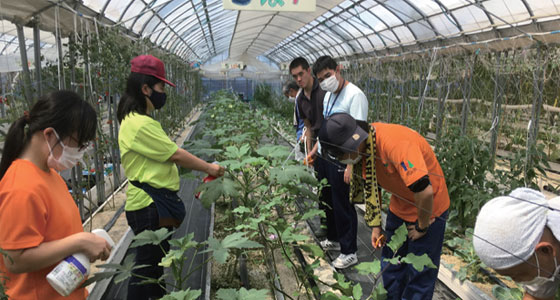
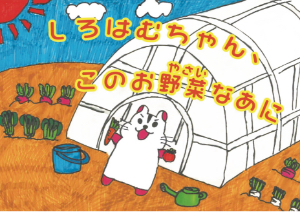
Donation of vegetables produced in Kashiwa Farm and Funabashi Farm to cafeterias for children in need
HASEKO Links conducts donation activities of vegetables produced in Kashiwa Farm and Funabashi Farm for local cafeterias for children in need (kodomo shokudo). Together with vegetables, we enclose a picture book mainly written by workers at Funabashi Farm for children to learn about vegetables and farmers.
Active participation of foreign personnel
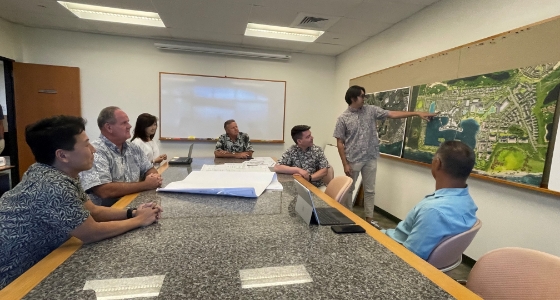
Haseko Corporation currently operates overseas businesses in the mainland United States, Hawaii, and Vietnam.
Upon expanding into these regions, we have established a local representative office, where we not only assign employees from Japan to take up a post but also hire local staff, and will continue to actively employ local staff in the future.
We have led the businesses to success by understanding each other’s way of thinking, culture and how to get the job done, which vary from place to place.

Active participation of senior personnel
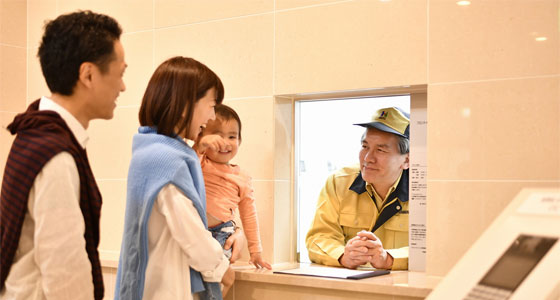
As efforts to adapt to the era of aging population in Japan, we believe it is important to secure and promptly train new recruits as a going concern and utilize the wealth of experience, skills and know-how of seniors on an ongoing basis to prepare against the aging population and declining birth rate. The Haseko Group has been one of the first organizations to work on the active participation of the elderly, having increased the mandatory retirement age from 60 to 65 in 2005, in view of such factors as developments in the legal system to adapt to the aging society and the effective utilization of human resources. As of the end of March 2025, 320 employees are actively working for a certain period of time even after mandatory retirement.
In the condominium management business, many seniors with extensive life experience—approximately 6,195 persons as of April 2025—are playing an active role in supporting condominium management and residents in their daily lives as "life managers" (administration staff).
In 2014, we introduced "Training Workshops for 60-year-old Employees," in which we give such employees the opportunity to look back at their corporate lives and think about how they can make the most of their career, what they can pass on to their successors, and what would be helpful in giving guidance to them. We also provide such employees with support in the five-year period until mandatory retirement so that they can engage in their main job and the training of their successors with a high level of motivation.
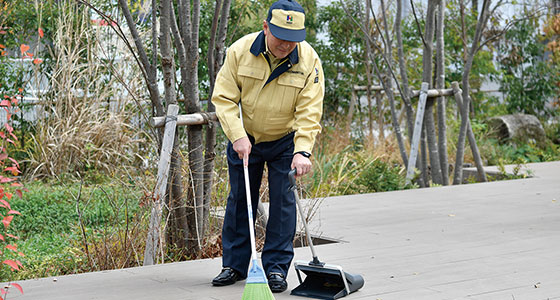
Employee interview
The Haseko Group respects the diversity of its employees, and strives to build an environment in which each person can leverage their individuality in their work.
Here we speak to our vibrant Group employees who works in the unique Haseko style.
Haseko Corporation currently operates overseas businesses in the mainland United States, Hawaii, and Vietnam.
I hope to bridge Japan and Vietnam and contribute to solving labor shortages
Tran Thi Thuy Dung
Overseas Human Resources Support Department, Haseko Job Create

Ms. Dung joined Haseko Job Create in 2021 and currently works in the Overseas Human Resources Support Department. Since joining Haseko, as a registered support organization for the specified skilled worker program, she has been working on matters such as recruitment and support activities for Vietnamese job seekers with specified skills in the nursing care industry, negotiating with employers, making human resources referrals, and applying for changes to visas of specified skilled workers. Recently, the construction industry has seen a growth in demand for foreign personnel, and the scope of work she handles for the construction industry is increasing.
Ms. Dung grew to like Japan as she was familiar with Japanese culture from young, due to the many Japanese companies in the vicinity of her parents’ home. As such, she began to study Japanese. She has a strong conviction to bridge the Japan and Vietnam and serve specified skilled Vietnamese workers as well as the companies that employ them. She feels an incredible sense of happiness and satisfaction from using Japanese and Vietnamese to share the appropriate information and provide support to Vietnamese job seekers and prospective Japanese employers.
While Japan and Vietnam are both located in Asia, their cultures are different. When they join their companies, Ms. Dung thoroughly trains specified skilled worker trainees on the fundamentals of Japanese culture, such as being punctual, greeting colleagues when arriving at work in the morning, and conveys the importance of these habits in building good relationships with the people around them. An attitude of respecting and accepting each other’s cultures is vital.
Going forward, Ms. Dung plans to direct more effort into sales activities, improve her proposal creation skills, and advance her understanding of prospective employers so as to be able to address their foreign personnel needs. Currently, Haseko Job Create is supporting 61 specified skilled Vietnamese workers, and is targeting to hire 100 of them per year. Having received many opportunities, Ms. Dung handles her work proactively and is excited to contribute to solving companies’ labor shortages.
- Department and role are correct as of the time (September 2024) of the interview.
Initiatives aimed at promoting understanding of D&I and putting it into practice
To promote understanding of D&I and put it into practice, we conduct the following initiatives aimed at creating a better workplace by encouraging all employees to think about “getting the most out of their qualities.”
Delivering information through an internal portal site “Together, we are building a company worth working at”
The Haseko Group operates an internal portal site, “Together, we’re building a company worth working at,” to deliver more information aimed at promoting D&I. In addition to messages from the Group’s senior management, it also introduces role models that represent different work styles, introduces the systems concerning childbirth, parenting, nursing care, etc., and covers various other career support information, while also serving as a forum for sharing opinions. Through this website, we are helping to “create a workplace environment where women can enjoy a long career” by primarily employee-led efforts.
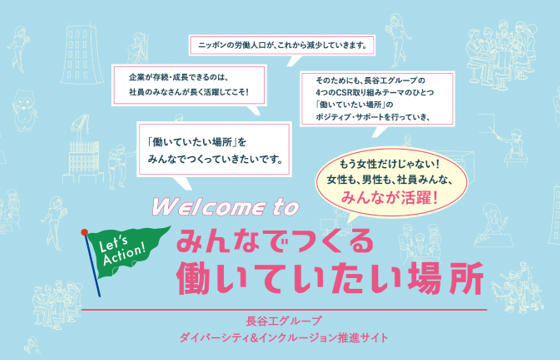
FY2024 initiatives
Implementation of e-learning
We conduct e-learning for all employees, including temporary employees, to deepen their understanding of basic D&I knowledge and unconscious bias, and encourage implementation in daily operations.
D&I training
We conduct training to managers at the general manager level and above on the themes of application of D&I to organizational management and management of diverse human resources, and support leaders in developing awareness and changing behaviors.
Building a Pleasant Working Environment (Labor Environment): Basic Approach & Policy
In order for each and every employee to play an active role by fully demonstrating his/her capabilities and skills, it is indispensable not only for employees to make efforts but also for a company to provide support to realize a pleasant workplace and improve productivity.
The Haseko Group has been promoting “MOSt (Move On Step) Activities,” aimed at executing operational reforms, improving productivity, alleviating prolonged work, taking days off from work, etc. In addition, Group companies and divisions are pushing ahead with their own voluntary initiatives to prevent overwork and develop a comfortable work environment.
Initiative Targets
◎: KPIs in the HASEKO Evolution Plan medium-term business plan
| Metrics | Targets* |
|---|---|
| ◎Implementation rate of operation with 8 days closed every 4 weeks | 100% (FY2027) |
| Implementation rate of operation with 8 days off every 4 weeks (104 days off annually) | 100% |
- Targets of the Haseko Corporation
For the results of initiatives, please refer to the ESG data.
Initiatives
MOSt Activities aimed at improving workplace environment on a Group-wide scale
Since FY2005, the Haseko Group has been engaging in MOSt Activities with the objective of creating an operating environment in which employees can seek physical and mental fulfillment and demonstrate their capabilities. "MOSt" is the abbreviation of "Move On Step," reflecting our commitment to "steadily engaging in activities by taking one step at a time."
In concrete terms, the MOSt Activities are being carried out under the initiative of the committees set up for this purpose in each division of Haseko Corporation and each Group company. Committee members selected from both labor and management set a theme or issue specific to their own workplace, discuss ways to solve them, and put them into practice. Information on these activities is shared among secretariat members of all committees on a regular basis and measures that proved effective are adopted at other workplaces as needed, thus helping to improve work environment across the Group.
Initiatives in 2024
In FY2024, we began activities under the slogan “Refresh your mind and body for peak performance!”
We worked to improve productivity and operational efficiency through the use of IT tools, awareness-raising activities for officers and employees, and other initiatives tailored specifically to each committee at Haseko Corporation’s various departments and Group companies.
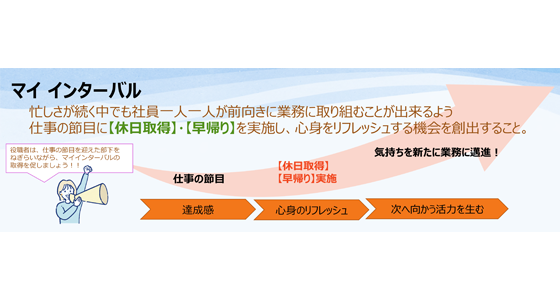
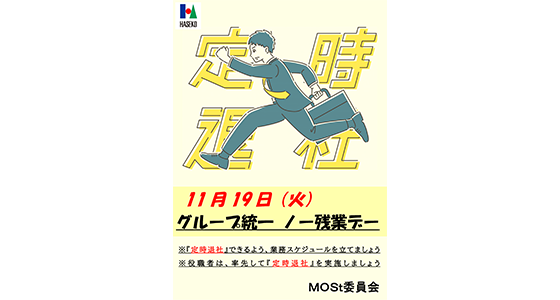
In addition to these committee-led activities, we carried out a range of Group-wide initiatives such as the My Interval initiative in which employees are encouraged to take leave and leave work at regular hours to correspond with seasonal fluctuations in the volume of work required, as well as the Group-wide No-Overtime Day (held twice a year) and the Division Early Leave Day conducted by each company and division, and generative AI study sessions.
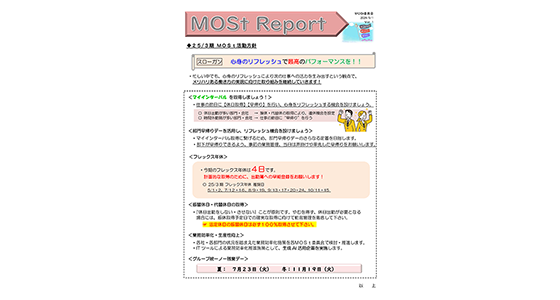
We also issue the MOSt Report once a month for the purpose of information sharing on and horizontal rollout of each committee’s activities, to raise awareness among officers and employees.
Realization of two days off a week at construction sites
The Japan Federation of Construction Contractors (JFCC) has established the Headquarters for Promoting Two Days Off a Week and formulated the Action Plan to Realize Two Days Off per Week. The JFCC has issued a policy urging companies to promote the taking of two days off per week during the three-month period from July to September 2024. This is to address the gap between industry practice and the industry-wide target of eight days of construction site closures every four weeks and the problem of operating with the maximum allowed amount of overtime work hours. Furthermore, it is expected that taking more leave during summer will lead to higher productivity in view of the extreme temperatures at sites which may lead to a slower pace of work, and will also prevent heatstroke. Haseko Corporation has established 108 designated construction site closure days per year and strongly encourages employees to take 104 days off each year, aiming for 100% achievement of the target of eight days of construction site closures every four weeks in FY2027.

Engagement with foreign workers from partner companies
Global Workers Meeting
For details of the initiatives, please see below.
MOSt Place, multipurpose space for the employees
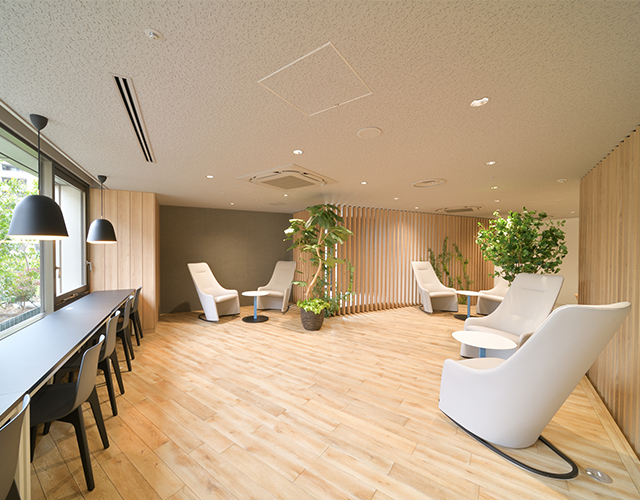
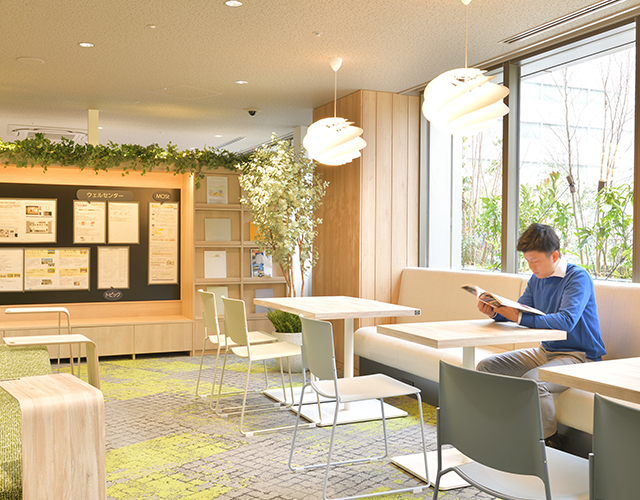
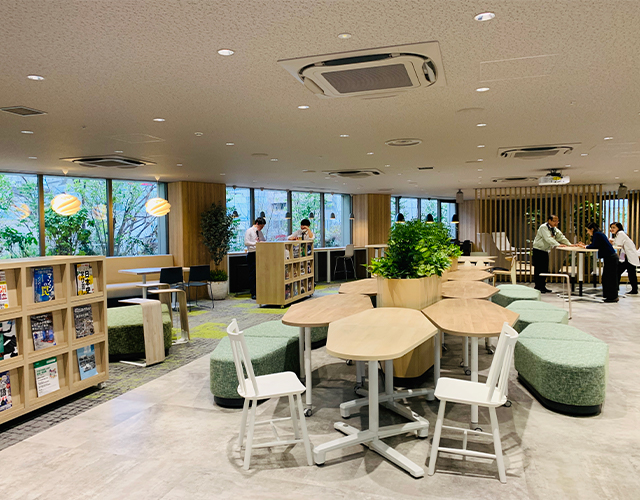
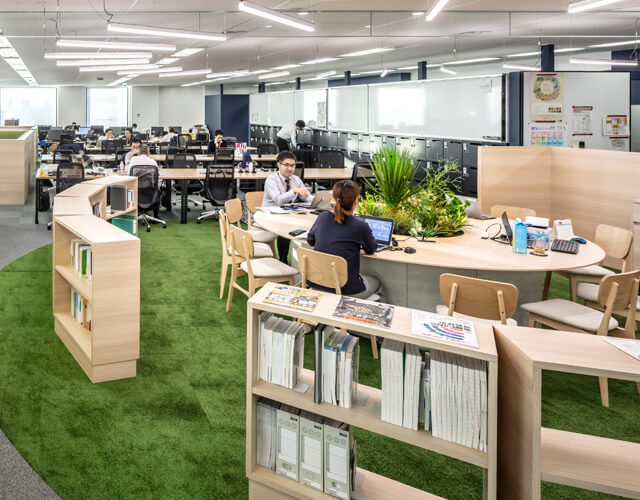
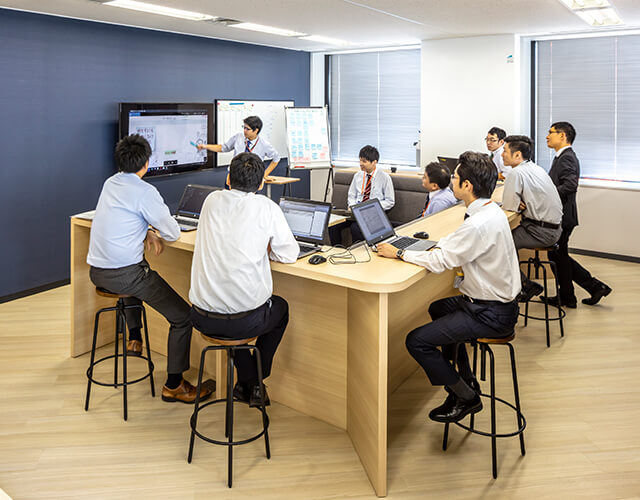
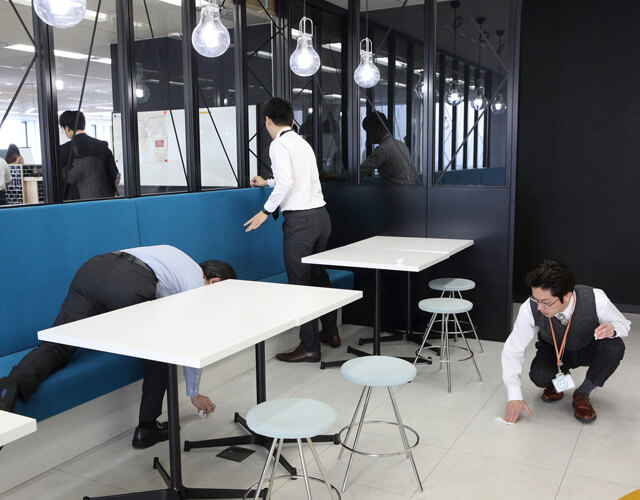
MOSt Place, multipurpose spaces for our employees, have been set up in the head office building in Shiba and also in the Hiranomachi building based on the concept of improving productivity and stimulating communication. It was designed as a space that sparks new ideas and inspirations, a space in which a variety of employees can mix and mingle, and a space where you can chill out. The space can be utilized flexibly, whether for meetings, working remotely or events in after-hours. We aspire to make it a place where each employee can unleash his/her potential and generate innovation.
Creative office in Value Creation Division
In Value Creation Division, which aims to create and verify Haseko Group's future businesses, improve the competitiveness of its products and services, and raise labor productivity, the office space has been designated as a "creative office" as a base to create innovation, the first of its kind in the Haseko Group.
Its concept is “Road Trip/Traveling Office” and it is entirely free address, being designed as an office space aimed at enabling employees to walk around freely in the work area as if they are on a trip, take advantage of the communication that incidentally arises among them and thereby yield steady results.
In addition, we launched a self-managed organization called Office Design Committee, which is engaged in such initiatives as aesthetic maintenance, promotion of communication, and greater disclosure/transparency of opinions and proposals for improvement of offices in an effort to maintain the creative office.
Initiatives on labor issues
Support of living wage
The Haseko Group conducts labor management in compliance with labor laws and regulations in each country and region. As for wages, we comply with minimum wage standards stipulated in each country and region, and pay higher wages than the standards as our basic policy.
We apply a uniform compensation system for employees in the same position and job level, regardless of gender, age, or other personal attributes.
The average annual salary of the Corporation was 10.58million yen in FY2024.
Labor-management relationship
The Haseko Group has nurtured labor-management relations built on mutual trust between the Group companies and the Haseko Group labor union, and believes that as a company, it is a fundamental necessity to respect the right of freedom of association, the right to organize, the right to collective bargaining, and the right to collective action, all of which are enshrined in its collective agreement. Aiming to realize a work-life balance for every union member and the development of the Group, the labor union collects voices from union members through questionnaires on their living and working conditions as well as meetings at worksites. Based on these voices, discussions and suggestions are made on equal footing through regular meetings between the employer and employees about developing a reassuring labor environment and measures for improving productivity. Each company takes these matters seriously to consider and implement various measures for the further development of the Group.
Risk assessment concerning labor issues
Each company in the Haseko Group monitors working hours as part of their employee work safety risk assessment, and reports the results to the Management Council on a monthly basis.
Based on the results of the monitoring, we take the following measures to ensure employee health and prevent overwork.
- We have formed MOSt (Move on Step) Committees composed of labor and management personnel at each division of Haseko Corporation and within each Group company, to examine measures to reform operations, enhance productivity, and shorten working hours.
- We have established Group-Wide No-Overtime Day (held twice a year) and Division Early Leave Day (held at least once a month) as common measures across the whole Group.
- We apply overwork interview rules that are stricter than the statutory criteria.
We also monitor the status of employee health and promote initiatives to maintain and improve the health of our personnel through the Haseko Group Health Management Promotion Committee.
In addition, when considering M&A, HASEKO Corporation assesses work safety risks as part of due diligence after confirming the target company's status of accidents and disasters, status of long-term absentees, and status of labor issues as the decision-making factors for such M&A.
Related Information
Haseko Group's Sustainability
Related Data / Integrated Report
Special Features
- Human Capital / Human Resource Development
- Diversity & Inclusion / Labor Environment
- Occupational Safety and Health / Health and Productivity Management
- Enhancing Safety and Quality in Buildings and Services
- New Value Creation
- Community
- Research and Technology Development
- Social Contribution Activities