
SEARCH
MENU
Corporate Governance
- Basic Approach & Policy
- Company Institutions
- List of Directors
- Training for Officers
- Evaluation of the Effectiveness of the Board of Directors
- Executive Remuneration
- Cross-Shareholdings
- Status of Audits
Basic Approach & Policy
Haseko Corporation has made it a basic policy of its corporate management to contribute to society and win society's confidence through its business operations that put customers first. The Company has also positioned reinforcement of corporate governance as one of its utmost management priorities as it recognizes that it is indispensable to secure management transparency and objectivity for maximizing corporate value in a stable manner over the long term and ensuring shareholders’ interests.
As part of its effort to achieve sustained growth and enhance corporate value over the medium- to long-term, the Company has formulated its Basic Policy on Corporate Governance and posted it on its website.
Company Institutions
Haseko Corporation has adopted an auditor system as a corporate institution. The Board of Directors of Haseko Corporation serves as the institution where directors with expert knowledge and experience in various business sectors conduct decision-making on managerial issues and supervise execution of duties of other directors. As for monitoring of management operations, the Company’s system provides the Board of Auditors, the majority of which are outside auditors, with the monitoring function from an objective and neutral standpoint from outside through implementation of audits. On top of these functions, starting in June 2016, Haseko appointed outside directors with abundant experience and track record to occupy at least one third of the Board of Directors, so that they shall provide appropriate opinions and advice in order to further activate discussions at the Board of Directors and enhance the function to monitor business management. With this system in place, we are making efforts to build an optimum system for the Company, taking into consideration the balance between the operation of the Board of Directors and the monitoring functions. In addition, the appointments of both inside directors and outside directors include a woman respectively, and we are continuing to work towards ensuring the diversity of the Board of Directors.
Decisions on certain matters authorized by the Board of Directors are made by the Management Council, Business Operation Council, and Technology Operation Council, each of which limits the participation of directors to a certain extent. In doing so, we have developed a system to separate the functions of decision-making and supervising such decision-making, so that each director can supervise the execution of duties by other directors. In addition, the Management Council is also responsible for the function of discussing in advance the important issues to be decided by the Board of Directors.
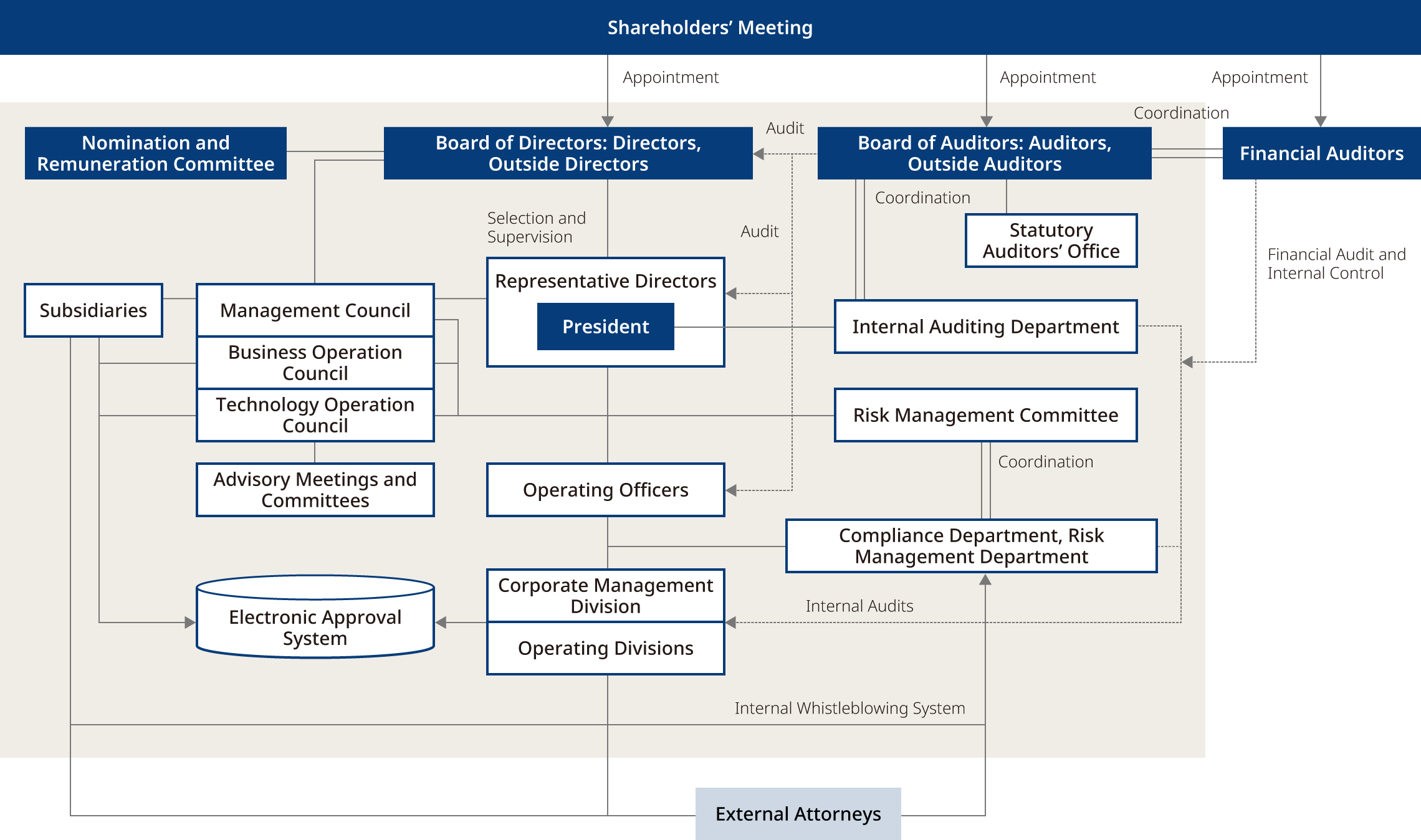
Details of company institutions
- The Board of Directors holds regular meetings once a month and extraordinary meetings as necessary, and is responsible for important decision-making and regular reports on matters related to management. In addition, operating officers make reports on business operations on a regular basis to the Board.
The Regulations of Board of Directors stipulate that a director who has a special interest in a resolution of the Board of Directors may not participate in said resolution. Furthermore, these regulations stipulate that any business which may cause a conflict of interest between the Company and directors, including directors conducting business with competing entities, business involving the Company and directors, business involving the Company with the director acting as a third party, and any debt guarantees provided for directors, shall be subject to the approval of the Board of Directors. -
The Nomination and Remuneration Committee is an advisory body for the Board of Directors, in order to secure objectivity, transparency, and fairness of the procedures related to the nomination, remuneration, etc. of directors and enhance corporate governance. The committee comprises all independent Outside Directors and an equivalent or below number of Representative Directors, etc.
The Nomination and Remuneration Committee met five times in FY2024 with all members (comprising two Inside Directors and five Outside Directors) in attendance.The succession plan for the President and Representative Director was discussed extensively with all outside directors at the Nomination and Remuneration Committee to establish the specific candidate pool and selection process. When selecting an appointment, the Nomination and Remuneration Committee reviews the backgrounds of all directors and screens candidates based on the succession plan.
- The company has established the Management Council and two operation councils - the Business Operation Council and the Technology Operation Council - to facilitate prompt and flexible decision-making on matters related to daily business operations to the extent they are authorized by the Board of Directors. Participation of directors in the Management Council and the two operation councils are limited to a certain level, so that the functions of decision-making and supervising such decision-making are divided and clarification is made for the responsibilities and authority for these functions. Moreover, the Management Council is responsible for the function of discussing in advance the important issues to be decided by the Board of Directors.
- The Risk Management Committee is held once every quarter and on an ad hoc basis as necessary whenever any material risk has arisen. It examines and determines the establishment, amendment or abolishment of internal rules on risk management and risk prevention plans, etc., and discusses and decides on the implementation policies and specific measures for risk management, among other things.
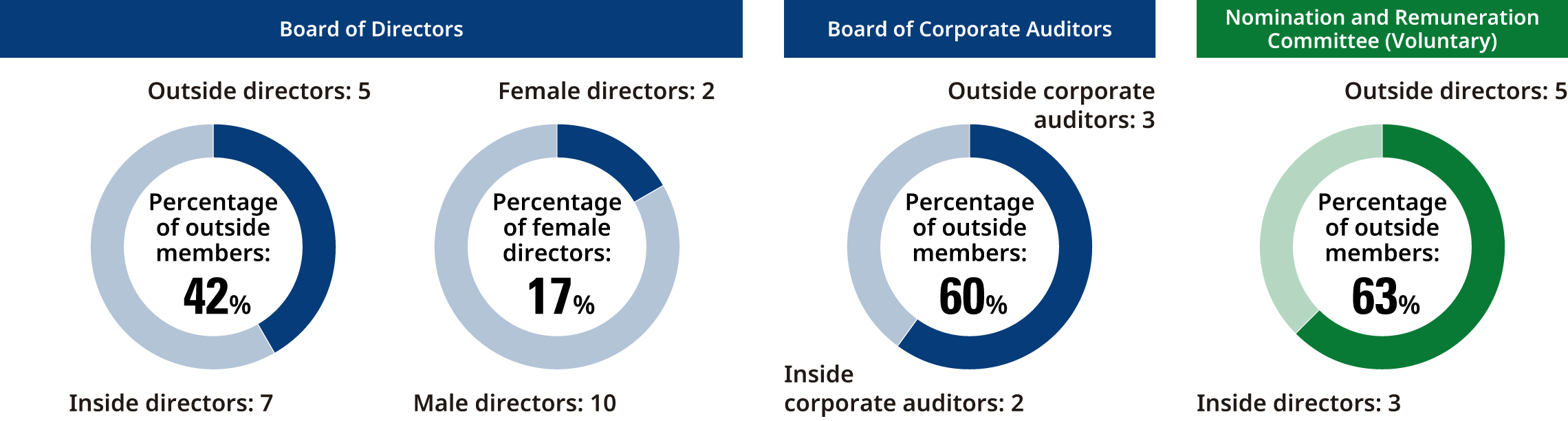
List of Directors
For a list of Directors and Corporate Auditors, please see Management Team.
For the independence criteria for outside officers, please see the appendix of Basic Policy on Corporate Governance.
- Management Team: About HASEKO
- Appendix of Basic Policy on Corporate Governance: Independence Criteria for Outside Officers
| Name | Positions/ Responsibilities in the Company |
Company management/ Management strategy |
Finance/ Accounting |
Legal affairs/ Risk management |
Overseas business | Construction/ Architecture |
Sales/ Real estate |
Urban development | Technology/ DX |
ESG/ Sustainability |
|---|---|---|---|---|---|---|---|---|---|---|
| Noriaki Tsuji | Chairman and Director |
● | ● | ● | ● | ● | ||||
| Kazuo Ikegami | Executive Vice Chairman and Representative Director |
● | ● | ● | ● | ● | ||||
| Satoshi Kumano | President and Representative Director |
● | ● | ● | ● | ● | ● | |||
| Kuniyoshi Mimori | Director, Executive Vice President |
● | ● | ● | ||||||
| Toru Yamaguchi | Director, Executive Vice President |
● | ● | ● | ||||||
| Takehiko Asano | Director, Senior Operating Officer |
● | ● | ● | ● | |||||
| Naoko Yoshimura | Director and Operating Officer |
● | ● | ● | ||||||
| Kazuhiko Ichimura | Outside Director (Independent) |
● | ● | ● | ● | ● | ||||
| Mami Nagasaki | Outside Director (Independent) |
● | ● | ● | ||||||
| Toshikatsu Ogura | Outside Director (Independent) |
● | ● | ● | ● | ● | ||||
| Takeshi Fujii | Outside Director (Independent) |
● | ● | ● | ● | ● | ||||
| Nobuaki Kitamori | Outside Director (Independent) |
● | ● | ● | ● | ● | ● |
Training for Officers
The Company has put in place an education system for Directors, Corporate Auditors, Operating Officers, other officers and employees to provide education and training relevant to their positions.
For Directors and Corporate Auditors, the Basic Policy on Corporate Governance stipulates that the Company will organize programs that offer seminars, etc., for acquiring essential knowledge and information, offer and help find training opportunities, and provide relevant financial support, and in accordance with this policy, the Company pays the costs of seminars and other programs in which Directors and Corporate Auditors have participated for self-development.
For Outside Directors, the Company provides an orientation program soon after they take office, where representatives from each department of the Company’s Corporate Management Division and each of the other divisions as well as from Group companies join to make presentations about businesses, operations, the Company’s current status and major issues facing the Company. In addition, the Company also offer them opportunities to visit the Company’s facilities and construction sites to promote their understanding of the Company’s businesses and individual projects. For Outside Corporate Auditors, the Company provides various reference materials about the Company, while also inviting them to participate in some of the visits to the Company’s facilities and construction sites, to help deepen their understanding of the Company’s businesses.
For operating officers as well as department managers and higher-level managers, the Company provides its Executive Leader Development Program, a training program that includes, among others, a New Managing Executive Officer Training Course, New Officer Training Course, School of New Corporate Management, and Corporate Management Course. The Company ensures that these training courses not only cover knowledge essential to their current positions, but also include knowledge necessary for Directors and Corporate Auditors, with the aim of nurturing future candidates for Director and Corporate Auditor.
Evaluation of the Effectiveness of the Board of Directors
We analyzed and evaluated the effectiveness of the Board of Directors for FY2024 in accordance with the Basic Policy on Corporate Governance, and confirmed that the Board of Directors held constructive and active discussions and was sufficiently effective.
Evaluation Method
We conducted a questionnaire regarding the effectiveness of the Board of Directors for all Directors and Corporate Auditors. Reflecting on the results of this questionnaire and reports from the secretariat on the operation of the Board of Directors in FY2024, deliberations were held and the effectiveness of the Board of Directors as a whole was analyzed and evaluated at the Board of Directors Meeting on April 18, 2025 based on opinions presented by the Board of Auditors and individual Directors.
Evaluation Items
| (i) Institutional Design/Composition | Number of members, percentage of independent Outside Directors, diversity, frequency of meetings, meeting length |
|---|---|
| (ii) Operation | Number and content of agenda items, quality and quantity of agenda materials, timing of prior distribution, quality of prior explanations |
| (iii) Deliberation | Constructive discussions and multifaceted considerations in meetings, ethos, one’s own roles and responsibilities |
| (iv) PDCA | Addressing issues raised, reporting results after resolutions, efforts toward improvement |
Response to Issues Raised During the FY2023 Evaluation
- Regarding the issue raised that strategic exchanges of opinion should be conducted more frequently, given that fiscal 2024 was the year of formulation of the HASEKO Evolution Plan (the new medium-term business plan that commenced in fiscal 2025), we held multiple opinion exchange sessions in addition to the Board of Directors meetings and engaged in vigorous discussions.
- Regarding the promotion of active discussions and exchanges of opinion on capital efficiency and management indicators, the introduction of management with an awareness of capital efficiency was actively discussed by the Board of Directors and incorporated into the HASEKO Evolution Plan.
- In response to requests for earlier distribution of materials to outside directors, information sharing, and elimination of information asymmetry, we have taken care to eliminate information gaps in internal information by enforcing a strict material provision deadline of two business days prior to Board of Directors meetings, conducting preliminary briefings for outside directors prior to Board of Directors meetings, and having the secretariat provide thorough explanations.
FY2024 Evaluation Results and Future Response
Evaluation Results
Compared with the FY2024 evaluation, items (i) through (iv) all remained highly consistent in general.
- As the final year in the medium-term business plan, in FY2024, the Board of Directors held active discussions on specific business issues as well as on responding to various changes in the environment surrounding society in order to achieve the goals of the management plan.
- Active deliberations were held, including multiple discussions to decide on policies for high-risk projects.
- When discussing the newly formulated medium-term business plan and other important matters, opinion exchange sessions were held outside the Board of Directors meetings to facilitate a multifaceted discussion.
- Reports were also made on a regular basis on future-oriented initiatives related to DX, and meaningful exchanges of opinions were conducted.
- In response to environmental changes surrounding society, active discussions were held to promote policies on sustainability initiatives, responses to climate change, human rights policy, harassment, etc. to higher levels.
Future Response
- To further improve the effectiveness of the Board of Directors, we will strive to stimulate discussion at the Board of Directors meetings from a medium- to long-term perspective in response to the key strategies set forth in the medium-term management plan.
- From a defensive standpoint, we will continue to work with even greater consideration on risk management, compliance, and other matters to which companies must adhere.
- To ensure that there is adequate time for discussion, we will implement measures such as shortening presentation times focused on regular business reports and other reported matters, and reviewing necessary materials.
Executive Remuneration
(1) Matters regarding the policy for determination of remuneration, etc. of individual directors
Method for determining the policy for determining remuneration
The basic policy for remuneration of Directors is stipulated in the Basic Policy on Corporate Governance, which was revised by the resolution of the Board of Directors in March 2021. In accordance with the Basic Policy on Corporate Governance, the remuneration of Directors is determined by resolutions of the Board of Directors based on the criteria for payment of remuneration of Directors prepared by the President in consideration of discussions at the Nomination and Remuneration Committee, which is comprised entirely of independent Outside Directors as well as Representative Directors, etc., numbering not more than the independent Outside Directors.
Summary of policy for determining remuneration of individual Directors, etc.
(a) Remuneration structure
- Directors’ remuneration consists of basic remuneration (fixed remuneration) and performance-linked remuneration.
(b) Basic remuneration
- Basic remuneration is a fixed, standard amount determined based on the Director’s position and paid once a month.
- The amount of basic remuneration is determined based on a comprehensive consideration of the position, duties, and term of office of each Director, taking into consideration the Company’s business performance, the level of employee salaries, and the level of remuneration of directors at comparable companies.
(c) Performance-linked remuneration
- Performance -linked remuneration consists of executive bonuses and stock remuneration. This system makes adjustments according to business performance, with the purpose of offering incentives for achieving business plans and increasing corporate value.
- The amount of basic remuneration is determined based on a comprehensive consideration of the position, duties, and term of office of each Director, taking into consideration the Company’s business performance, the level of employee salaries, and the level of remuneration of directors at comparable companies.
- As the medium-term business plan sets consolidated ordinary income as a specific numerical target, achievement status for consolidated ordinary income relative to the initial forecast as of the beginning of each fiscal year as well as year-on-year change are used as performance indicators.
- In principle, outside directors and corporate auditors are not eligible for performance-linked remuneration.
Formula for calculation of executive bonuses
- Amount of bonus = Standard amount based on position × Performance coefficient + Director’s allowance
- The performance coefficient is determined based on actual consolidated ordinary income compared to the target consolidated ordinary income set in the business plan and compared to the previous year’s performance. For directors at the level of executive operating officers and lower, the performance of the divisions they are responsible for is taken into account.
- Bonuses are determined based on the position of each Director at the end of the fiscal year under review and paid annually, generally after the Ordinary General Meeting of Shareholders held in June.
Formula for calculation of stock remuneration
- Points awarded = Amount of bonus x 0.3 x corporate value improvement coefficient/book value of BBT (Board Benefit Trust) per share
- The corporate value improvement coefficient is determined based on the achievement level of capital efficiency indicators and non-financial indicators such as human capital management (including health and safety) and response to climate change.
- Determined with reference to position held as of the end of the fiscal year in question, and generally awarded on June 1 every year.
- Upon retirement, the total number of points accumulated as of the retirement date are exchanged for company stock and delivered to the director, at the rate of one stock per point.
(d) Ratio of basic remuneration to performance-linked remuneration (executive bonuses and stock remuneration)
- The ratio of basic remuneration: executive bonuses : stock remuneration is approximately 47: 41: 12. The ratio of basic remuneration: performance-linked remuneration for directors (excluding outside directors) is determined based on a fixed formula in accordance with a structure that allows for adjustment commensurate with business performance.
(2) Reasons that the Board of Directors has judged that the remuneration of individual Directors is determined in compliance with the policy
The remuneration of individual Directors for the fiscal year under review has been determined by the resolution of the Board of Directors based on the policy for determination of remuneration of individual Directors, etc., stated above in consideration of discussions at the Nomination and Remuneration Committee, which is comprised entirely of independent Outside Directors as well as Representative Directors, etc., numbering not more than the independent Outside Directors. Therefore, the Company believes that it is in compliance with the said policy.
(3) Matters regarding the resolution of the general meeting of shareholders on remuneration of Directors and Corporate Auditors, etc.
It was resolved at the 91st Ordinary General Meeting of Shareholders held on June 27, 2008 that the monetary remuneration of Directors shall be a maximum amount of 700 million yen per year (provided that, of the 700 million yen, 200 million yen shall be paid as bonuses for Directors on the condition that dividend of surplus is paid on common stock). The number of Directors was 12 at the time of closing of the 91st Ordinary General Meeting of Shareholders. It was also resolved at the 100th Ordinary General Meeting of Shareholder held on June 29, 2017 that, separately from the above maximum amount of monetary remuneration, a performance-based stock compensation scheme for Directors (excluding Outside Directors) shall be introduced as a measure to help enhance the Company’s business performance and corporate value over the medium- to long-term and that a maximum amount of 320 million yen shall be contributed to the scheme for every five fiscal years. In addition, it was resolved at the 104th Ordinary General Meeting of Shareholders held on June 29, 2021, that the scheme shall be reset with the additional condition that the maximum number of shares to be repurchased every five fiscal years shall be 360 thousand shares. The number of Directors (excluding Outside Directors) was 8 at the time of closing of the 100th Ordinary General Meeting of Shareholders and 8 at the time of closing of the 104th Ordinary General Meeting of Shareholders.
More recently, it was resolved at the 107th Ordinary General Meeting of Shareholders held on June 27, 2024 that the limit of monetary remuneration of directors be raised by 200 million yen to a maximum of 900 million yen per year (provided that 400 million yen of the 900 million yen shall be paid as bonuses for directors on the condition that dividends of surplus are paid on common stock). The number of directors was 12 at the time of closing of the 107th Ordinary General Meeting of Shareholders.
At the 108th Ordinary General Meeting of Shareholders held on June 27, 2025, it was resolved to revise the specific calculation method for the Company shares to be granted in performance-linked stock remuneration scheme for Directors (excluding Outside Directors).
It was resolved at the 77th Ordinary General Meeting of Shareholders held on June 29, 1994 that the monetary remuneration for Corporate Auditors shall be a maximum amount of 100 million yen per year. The number of Corporate Auditors was four at the time of closing of the 77th Ordinary General Meeting of Shareholders.
(4) Total amount of remuneration, etc., of officers for FY2024
| Category | Number of eligible officers | Amount of remuneration, etc., by type | Total | |||
|---|---|---|---|---|---|---|
| Basic remuneration | Performance-linked remuneration, etc. | Others | ||||
| Executive bonuses | Stock remuneration | |||||
| Directors (of which, Outside Directors) |
15 persons (5 persons) |
381 million yen (60 million yen) |
159 million yen (-) |
46 million yen (-) |
- (-) |
586 million yen (60 million yen) |
| Corporate Auditors (of which, Outside Corporate Auditors) |
6 persons (3 persons) |
72 million yen (31 million yen) |
- (-) |
- (-) |
- (-) |
73 million yen (31 million yen) |
| Total | 21 persons | 454 million yen | 159 million yen | 46 million yen | - | 659 million yen |
- The Company has introduced stock remuneration through a trust established in accordance with the Board Benefit Trust (BBT), which in principle grant the Company’s stocks to the Group’s officers at the time of retirement. The amount of stock remuneration is an amount equivalent to the stock remuneration expensed for the fiscal year under review based on the scheme.
- For the performance indicators used as a basis for calculation of the amount or the number of performance-linked remuneration, the Company applies the level of consolidated ordinary income for the fiscal year under review as compared to the forecast at the beginning of the year and change in consolidated ordinary income from the previous fiscal year as the Company has designated consolidated ordinary income as a specific target in the medium-term management plan.
- The remuneration of Corporate Auditors is determined based on discussions between the Corporate Auditors and does not exceed the maximum amount determined by the resolution of the General Meeting of Shareholders.
Cross-Shareholdings
In the case where holding shares of our business partners will help facilitate the operation of business, Haseko’s policy is to hold shares as cross-shareholdings in accordance with the Guidelines for Asset Acquisition in Facilitating Transactions that is separately prescribed.
The guideline states that the total book value for assets acquired shall be about a prescribed amount of the consolidated net assets.
Haseko examines cross-shareholdings individually in terms of medium- to long-term economic rationale and future projections annually at a Board of Directors meeting, and if any shares are determined to be without merit in holding, then those shares will be reduced or otherwise reconsidered. The Board of Directors confirms the status in transactions for the businesses relevant to the cross-shareholdings once every year, including annual amounts of orders received and purchase amounts for those businesses to deliberate the feasibility of continuing shareholding.
| Number of issues | Amount recorded in the balance sheet (million yen) | |
|---|---|---|
| Unlisted shares | 12 | 238 |
| Stock other than unlisted shares | 5 | 25,481 |
Issue for which number of shares increased in FY2024
There are no relevant matters.
| Number of issues | Total sale amount associated with decreased shares (million yen) | |
|---|---|---|
| Stock other than unlisted shares | 1 | 601 |
Status of Audits
Status of audits by corporate auditors
Haseko Corporation is a company with the Board of Corporate Auditors. It consists of five corporate auditors, of which two are full-time and three are outside, and meets once every month and on an ad hoc basis as necessary.
At meetings of this board, deliberations and discussions are held and resolutions are made on specific matters including the formulation of audit plans such as audit policies and division of duties, preparation of audit reports, evaluation of Accounting Auditors, judgments on whether to reappoint Accounting Auditors in accordance with the Policy on Decisions for the Dismissal or Non-Reappointment of Accounting Auditors, and consent to audit fees and other related matters.
The Board of Corporate Auditors also receives reports from directors, operating officers, presidents of Group companies, and other such parties, and also receives activity reports from full-time auditors. All auditors attend monthly liaison meetings with the Audit Department and the Risk Management Department, where they share information and exchange views based on regular reports on the status of development and operation of internal control systems, evaluations of internal controls related to financial reporting, and other relevant matters. In addition, all auditors hold separate meetings with representative directors and outside directors respectively, to exchange views and ensure effective communication.
The two full-time corporate auditors cooperate with each other to conduct audit activities including an audit of the Company’s internal control system. More specifically, the corporate auditors attend the Management Council, Business Operation Council, Technology Operation Council, Risk Management Committee, and other important meetings, observe internal audits, interview directors and other officers and employees about the status of business operations as necessary, and inspect approval documents, minutes, meeting materials, and reports, among others. The corporate auditors also hold a Group Corporate Auditors’ Liaison Meeting to cooperate with Group companies’ corporate auditors.
In accounting audits, all the corporate auditors meet with Ernst & Young ShinNihon LLC., the accounting auditor of the Company, to receive the explanations of accounting audit plans, interim reviews, and accounting audit reports from the accounting auditor. As necessary, the full-time corporate auditors interview the Accounting Department and the accounting auditor.
Status of internal audits
In internal audits, the Internal Auditing Department comprised of 11 members conducts internal audits of information management, risk management, etc. and assesses internal control over financial reporting. Whenever internal control issues are found in an accounting audit, information on the issues is communicated to each division, and improvements to resolve the issues are considered. At the same time, as part of the assessment of internal control, the Internal Auditing Department obtains the information, gives feedback to each division, and monitors the progress of improvements made in each division. The Internal Auditing Department also reports the status of such improvements to the President, the Board of Directors, corporate auditors, and the accounting auditor.
Further, the Internal Auditing Department carries out such activities while reporting the status of them to corporate auditors as appropriate in order to coordinate the roles of internal audits with the roles of audits by the Board of Corporate Auditors and ensure consistency between these roles. Corporate auditors observe internal audits, receive the reports of internal audit results, and exchange information about in-house status with the Internal Auditing Department as appropriate.
The periodic rotation and re-engagement of financial auditors are enacted as follows, pursuant to the presiding regulations for audit corporations in accordance with the Certified Public Accountants Act and other relevant legislation.
- The lead engagement partner may not re-engage with the Company once he/she has exceeded a term of five consecutive accounting periods.
- Other engagement partners may not, after having engaged with the Company for seven consecutive accounting periods, re-engage with the Company again for five consecutive accounting periods.
Haseko Group's Sustainability
Related Data / Integrated Report
Special Features
- Human Capital / Human Resource Development
- Diversity & Inclusion / Labor Environment
- Occupational Safety and Health / Health and Productivity Management
- Enhancing Safety and Quality in Buildings and Services
- New Value Creation
- Community
- Research and Technology Development
- Social Contribution Activities